- Reference
- Syst.Veg. 3:765 (1826)
- Conservation Code
- Not threatened
- Naturalised Status
- Alien to Western Australia
- Name Status
- Current
Rhizomatous (tuber-like), perennial, herb, to 1 m high. Fl. white, Jul to Nov. Loam, sand. Swamps, rarely uplands.
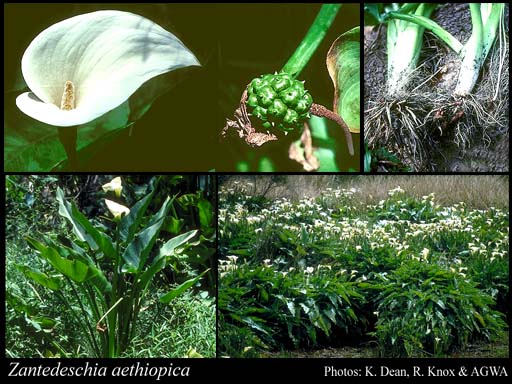
Distribution
- IBRA Regions
- Avon Wheatbelt, Geraldton Sandplains, Jarrah Forest, Swan Coastal Plain, Warren.
- IBRA Subregions
- Dandaragan Plateau, Geraldton Hills, Katanning, Merredin, Northern Jarrah Forest, Perth, Southern Jarrah Forest, Warren.
- IMCRA Regions
- Leeuwin-Naturaliste, WA South Coast.
- Local Government Areas (LGAs)
- Albany, Armadale, Augusta Margaret River, Bayswater, Bunbury, Busselton, Capel, Cockburn, Cuballing, Dandaragan, Donnybrook-Balingup, Gingin, Gosnells, Kalamunda, Manjimup, Mundaring, Nannup, Nedlands, Northampton, Rockingham, Serpentine-Jarrahdale, Swan, Victoria Plains, Wanneroo, West Arthur, Williams, Wyalkatchem.
Management Notes (for the Swan NRM Region)
Common Names. Calla Lily, Pig Lily, Lily of the Nile, Trumpet Lily, Funeral Flower
Synonyms. Calocasia aethiopica D.I.Morris
Classification. Declared Pest in Western Australia under s22(2) of the BAM Act 2007. Check legal status in the Western Australian Organism List.
General Biology. Growth form. Geophyte. Life form. Perennial tuberous rhizome. Reproduction. Seed and vegetative growth (rhizomes). Dispersal. Spread of seed and rhizome fragments via water, birds, dumped garden waste, and contaminated soil. Time to first flowering. 2-4 years (from seed). Seedbank persistence. Short-term, rarely viable after 4 months. Fire response. Generally survives fire.
Notes. All parts of the plant are toxic to people, pets, and stock. Seed is slow to germinate and not affected by exposure to light. No reported allelopathy. Note that Arum Lily is not a true lily nor an Arum species, although both Zantedeschia (the ‘calla lilies’) and Arum belong to the Araceae family. Arum lily shoots (above-ground) will die back to an underground tuberous rhizome over summer, then re-emerge with new growth in Autumn.
Additional information. Origin. Native to southern Africa. History of use/introduction. Introduced to Australia as an ornamental and was distributed widely by nurseries for the garden and floristry trades. Similar exotic species. When not in flower, Arum Lily can be easily mistaken for other Aroid (Araceae) plants, particularly popular garden and house plants such as Elephant's Ear (Caladium bicolor), Native Cunjevoi (Alocasia brisbanensis), Italian Arum (Arum italicum), Taro (Colocasia esculenta), and Philodendron.
Management and Control
Targeted chemical control is recommended to achieve effective management of arum lily in natural environments. Map the weed extent and density, develop an integrated weed management plan, monitor, and follow up.
Chlorsulfuron and metsulfuron (group 2, sulfonylureas) are the most effective and selective herbicides for controlling arum lily. Spray actively growing plants with chlorsulfuron 750 g/kg (e.g. Glean®) at 1 g/10 L water + 25mL penetrant (e.g. Pulse), or metsulfuron 600 g/kg at 1 g/10 L + penetrant, ensuring full leaf coverage. Metsulfuron is less persistent in the soil but is also less selective, so be mindful of spray drift impact. The ideal time to spray is from flower stem emergence when all leaves have unfurled (maximum leaf area), until immature seed set (prior to seed expansion and turning yellow). Note that chlorsulfuron and metsulfuron are slow-acting, so evidence of herbicide activity (i.e. yellowing and plant death) may not be visible until months after treatment.
*Refer to minor use permit PER93063 (expiry 31 May 2028) conditions of use for using chlorsulfuron products to control declared plants (i.e. arum lily).
Note that glyphosate (e.g. Roundup®) may be added to a herbicide mix but is not recommended as the sole or dominant active ingredient for treating arum lily. Paraquat and diquat provide fast and effective control for arum lily but are more costly and environmentally toxic.
Follow up is essential for effective management and control of arum lily. Large infestations can have more than 100 tonnes/ha of rhizomatous biomass, requiring follow up for a minimum of 2-3 years to ensure chemical treatment exhausts the entire rhizome network.
Hand removal requires the removal of all parts of the plant and its’ daughter rhizomes to achieve effective control. The resulting soil disturbance may encourage germination and establishment of other weeds, so it is not recommended as a suitable option for controlling established infestations in natural environments.
Read the manufacturers' labels and material safety data sheets before using herbicides. For further information consult the Australian Pesticides and Veterinary Medicines Authority to determine the status of permits for your situation or state.
Visit Nature Conservation Margaret River Region’s Arum Lily Blitz program page for further information and resources on controlling arum lily.
Management Calendar
| Calendar Type | Jan | Feb | Mar | Apr | May | Jun | Jul | Aug | Sep | Oct | Nov | Dec | Comments |
|---|---|---|---|---|---|---|---|---|---|---|---|---|---|
| Dormant | Y | Y | Y | Y | Y | ||||||||
| Active Growth | Y | Y | Y | Y | Y | Y | |||||||
| Flowering | O | O | O | O | O | O | Y | Y | Y | Y | Y | Y | Often staggered |
| Germination | Y | Y | Y | Y | Y | ||||||||
| Optimum Treatment | Y | Y | Y | Y |
Legend: Y = Yes, regularly, O = Occasionally, U = Uncertain, referred by others but not confirmed.
References
-
Brown, K. & Brooks, K. (2002) Bushland Weeds: A Practical Guide to their Management. Environmental Weeds Action Network, Greenwood.
-
Brown, K. & Brooks, K. (2002) Managing weeds in bushland brochure: Arum Lily (Zantedeschia aethiopica). Environmental Weeds Action Network. https://library.dbca.wa.gov.au/#record/215106
-
Francis, A., Griffin, S. & Wykes, B.A. (2002) Arum Lily Herbicide Experiment HMAS Stirling Garden Island. HMAS Stirling Environmental Working Paper No. 14.
-
Hanran-Smith, G., Walker, O. & Howell, B. (2024) Arum Lily Blitz. Nature Conservation Margaret River Region. natureconservation.org.au/
-
Hussey, B.M.J., Keighery, G.J., Dodd, J., Lloyd, S.G. & Cousens, R.D. (2007) Western Weeds. A guide to the weeds of Western Australia. 2nd Edition. The Plant Protection Society of Western Australia, Victoria Park.
-
Minister for Agriculture and Food, Western Australia. (2006, August 31) Arum lilies banned from sale [media statement]. www.wa.gov.au/
-
Moore, J.H. (2024, September 9) Controlling arum lily with DPIRD's John Moore [webinar]. Nature Conservation Margaret River Region. www.youtube.com/watch?v=5iqSwVkn_SM
-
Moore, J.H. (1997) Arum Lily: a general description. In Arum Lily (Zantedeschia aethiopica), Proceedings of a workshop held at HMAS STIRLING, Garden Island, Western Australia (eds. J.K. Scott & B.J.Wykes). CRC for Weed Management Systems, Adelaide.
-
Moore, J.H. & Hoskins, E.B. (1997) Arum Lily control in south west Western Australia. In Arum Lily (Zantedeschia aethiopica), Proceedings of a workshop held at HMAS STIRLING, Garden Island, Western Australia (eds. J.K. Scott & B.J.Wykes). CRC for Weed Management Systems, Adelaide.
-
Nature Conservation Margaret River Region. (2019) Arum lily control: Nature conservation information sheet. Nature Conservation Margaret River Region.