- Reference
- Nuytsia 6: 312-313, Fig.2 (1988)
- Conservation Code
-
Threatened
A taxon name retains its ‘Threatened’ status until a new name has been officially endorsed and appears in the Gazettal Notice.
- Naturalised Status
- Native to Western Australia
- Name Status
- Current
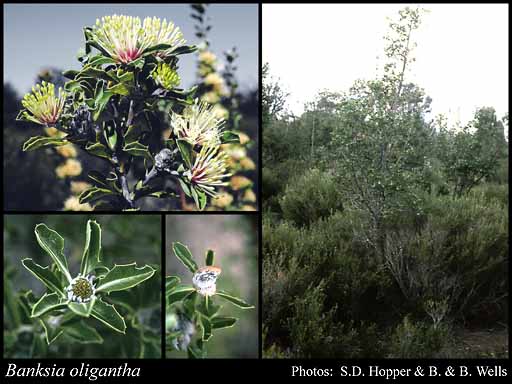
Non-lignotuberous shrub, to 3 m high. Fl. red & cream/orange-brown, Oct to Nov. Yellow or yellow-brown sand.
Scientific Description
Shrubs, 2-3.5 m high; branchlets hairy. Leaves petiolate, alternate, 20-40 mm long, 10-20 mm wide, hairy; petiole 10-15 mm long; lamina flat, clearly widest above the middle, once divided, pinnately divided, shallowly divided, teeth pointing outwards, with 3-6 lobes on each side, the margins flat. Inflorescences tomentose (with matted or tangled, soft, woolly hairs), yellow; innermost bracts 3-5 mm long, hairy. Perianth 17-19 mm long, glabrous, without awns; pistil 20-22 mm long, straight, style glabrous. Follicles hairy, tomentose (with matted or tangled, soft, woolly hairs), ovate, 14-19 mm long. Flowers in October or November. Occurs in the South-west (SW) Botanical Province(s), in the Avon Wheatbelt (AW) or Jarrah Forest (JF) IBRA subregion(s). : Conservation code Threatened (T).
Distribution
- IBRA Regions
- Avon Wheatbelt, Jarrah Forest, Swan Coastal Plain.
- IBRA Subregions
- Katanning, Perth, Southern Jarrah Forest.
- Local Government Areas (LGAs)
- Kojonup, Narrogin, Perth, Wagin, Wickepin.