- Reference
- Nuytsia 1:202 (1971)
- Conservation Code
- Not threatened
- Naturalised Status
- Native to Western Australia
- Name Status
- Current
Spreading shrub, 0.3-0.8 m high. Fl. pink, Aug to Dec or Feb. Gravel, clay, loam. Breakaways, ironstone slopes.
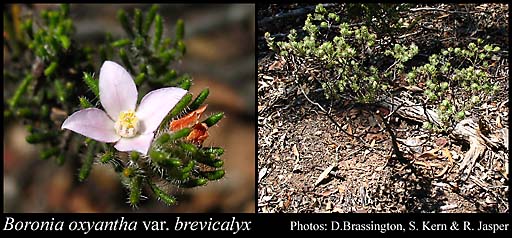
Scientific Description
Shrub, spines absent; branchlets smooth, without distinct raised glands, +/- cylindrical in cross-section, covered in hairs or scales, the hairs stellate (star-shaped). Leaves opposite, compound, 8-9 mm long, with 3 leaflets, each 7-9 mm long, 0.8-1 mm wide, flat, the margins flat, smooth, without distinct raised glands, covered in hairs or scales, with stellate (star shaped) hairs; stipular excrescences absent. Flowers axillary, solitary; pedicels 2.5-5 mm long; calyx present, 1.5-3 mm long, smooth, without distinct raised glands, covered in hairs or scales, the hairs stellate (star-shaped); corolla pink, petals four, 5-10 mm long, imbricate (overlapping), free, glabrous; stamens twice as many as petals, 1.5-2 mm long, smooth, ciliate (with a marginal fringe of hairs); anthers 0.5 mm long, with an appendage; style 0.5 mm long. Flowers in February, August, September, October, November and December. Occurs in the South-West Botanical Province, in the Esperance IBRA region(s).
Distribution
- IBRA Regions
- Esperance Plains.
- IBRA Subregions
- Fitzgerald, Recherche.
- Local Government Areas (LGAs)
- Albany, Gnowangerup, Jerramungup, Ravensthorpe.