- Conservation Code
- Not threatened
- Naturalised Status
- Native to Western Australia
- Name Status
- Current
Rhizomatous, perennial, herb, 0.1-0.3(-1) m high. Fl. yellow&red/orange, Jul to Oct. Sand, sandy loam over laterite or limestone. Well drained areas.
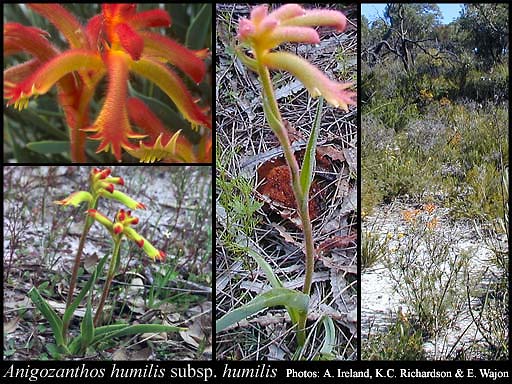
Scientific Description
Leaves flat, 55-100 mm long, 5-11 mm wide; bristles or hairs on the leaf margin absent, with at least some small side branches at the base; hairs on the surface of the leaf present. Scape present, hairy, 125-250 mm long. Inflorescence subtended by a bract 20-30 mm long, with several flowers; floral bracts 10-15 mm long; pedicels present, 2.5-5 mm long; flowers 30-45 mm long. Perianth hairy, bilaterally symmetric, suffused with a darker colour over the base colour, yellow or red, with six more or less equal tepals, the inner segments 7-11 mm long. Stamens six, in three levels, in pairs; filaments 3-3.7 mm long; anther 2.5 mm long, without an appendage. Style 23-28 mm long. Flowers in July, August, September or October. Occurs in the Geraldton Sandplains, Swan Coastal Plain, Avon Wheatbelt, Jarrah Forest, Mallee and Esperance IBRA bioregion(s), of the South-west Botanical Province.
Distribution
- IBRA Regions
- Avon Wheatbelt, Esperance Plains, Geraldton Sandplains, Jarrah Forest, Mallee, Swan Coastal Plain.
- IBRA Subregions
- Dandaragan Plateau, Fitzgerald, Geraldton Hills, Katanning, Lesueur Sandplain, Merredin, Northern Jarrah Forest, Perth, Recherche, Southern Jarrah Forest, Western Mallee.
- IMCRA Regions
- Central West Coast, Leeuwin-Naturaliste.
- Local Government Areas (LGAs)
- Albany, Bayswater, Beverley, Broomehill-Tambellup, Bruce Rock, Bunbury, Busselton, Carnamah, Chapman Valley, Chittering, Claremont, Cockburn, Coorow, Cottesloe, Cranbrook, Dandaragan, Dardanup, Donnybrook-Balingup, Dowerin, Dumbleyung, Gingin, Gnowangerup, Goomalling, Gosnells, Greater Geraldton, Irwin, Jerramungup, Joondalup, Kalamunda, Kellerberrin, Kent, Kojonup, Kulin, Kwinana, Lake Grace, Mandurah, Manjimup, Melville, Mingenew, Moora, Mundaring, Murray, Narrogin, Northam, Northampton, Perth, Pingelly, Plantagenet, Ravensthorpe, South Perth, Stirling, Swan, Three Springs, Toodyay, Victoria Plains, Wagin, Wandering, Wanneroo, West Arthur, Wickepin, Wongan-Ballidu, Woodanilling, Wyalkatchem, York.