- Reference
- Brunonia 1:350,Fig.1 (1978)
- Conservation Code
-
Threatened
A taxon name retains its ‘Threatened’ status until a new name has been officially endorsed and appears in the Gazettal Notice.
- Naturalised Status
- Native to Western Australia
- Name Status
- Current
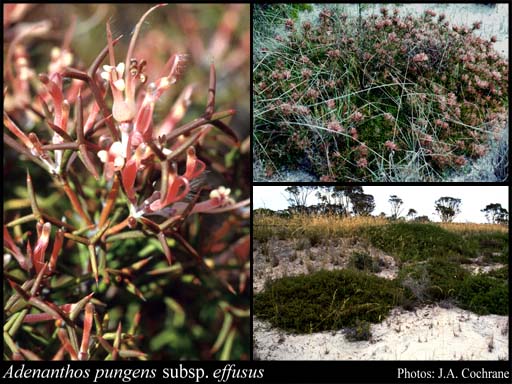
Prostrate shrub, to 0.5 m high, forming large mats to 3 m wide. Fl. pink, Aug to Nov. White siliceous sand.
Scientific Description
Prostrate shrubs, 0.15-1.5 m high. Leaves alternate, 15-40 mm long, 0.5-1.5 mm wide, hairy; lamina terete, more or less the same width throughout, once divided, tripartitely divided, entire or divided to the midrib, with glands on the surface of the leaf blade. Inflorescences pink; innermost bracts 2.5-3 mm long; peduncles 3-5 mm long. Perianth 16-17 mm long, hairy; ovary glabrous; pistil 26-31 mm long, pollen presenter erect, style hairy or glabrous. Flowers in April, May, June, July, August, September, October or November. Occurs in the South-west (SW) Botanical Province(s), in the Avon Wheatbelt (AW) or Jarrah Forest (JF) IBRA subregion(s). : Conservation code Threatened (T).
Distribution
- IBRA Regions
- Avon Wheatbelt, Jarrah Forest.
- IBRA Subregions
- Katanning, Southern Jarrah Forest.
- Local Government Areas (LGAs)
- Broomehill-Tambellup, Katanning, Kojonup, Woodanilling.