- Reference
- Brunonia 1:375-6 (1978)
- Conservation Code
- Not threatened
- Naturalised Status
- Native to Western Australia
- Name Status
- Current
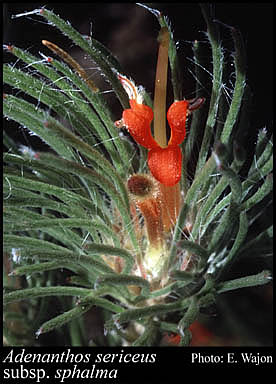
Shrub, 0.5-2 m high, leaves rarely exceeding 30 mm long. Fl. red, Jan to Apr or Jun or Aug to Dec. White or grey sand. Among granite or quartzite outcroppings.
Scientific Description
Shrubs, 0.5-2 m high. Leaves alternate, 15-35 mm long, glabrous; lamina terete, once divided, tripartitely divided, divided to the midrib, with glands at the leaf (or leaf lobe) apex. Inflorescences red; innermost bracts 4-5 mm long; peduncles 2.5-3 mm long. Perianth 24-25 mm long, hairy; ovary glabrous; pistil 33-36 mm long, pollen presenter erect, style glabrous. Flowers in January, February, March, April, May, June, July, August, September, October, November or December. Occurs in the South-west (SW) Botanical Province(s), in the Mallee (MAL) or Esperance Plains (ESP) IBRA subregion(s).
Distribution
- IBRA Regions
- Esperance Plains, Mallee.
- IBRA Subregions
- Eastern Mallee, Recherche.
- IMCRA Regions
- WA South Coast.
- Local Government Areas (LGAs)
- Esperance.