- Reference
- Fl.Australia 45:455 (1987)
- Conservation Code
-
Threatened
A taxon name retains its ‘Threatened’ status until a new name has been officially endorsed and appears in the Gazettal Notice.
- Naturalised Status
- Native to Western Australia
- Name Status
- Current
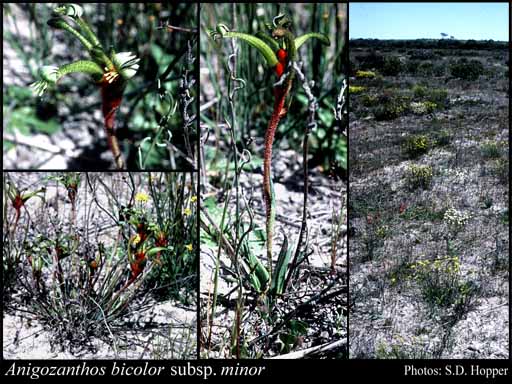
Rhizomatous, perennial, herb, 0.05-0.2 m high. Fl. green&red, Aug to Oct. Sand. Well-watered sites.
Scientific Description
Leaves flat, 60-90 mm long, 1-2 mm wide; bristles or hairs on the leaf margin absent; hairs on the surface of the leaf absent (leaf surfaces glabrous). Scape present, hairy, 80-120 mm long. Inflorescence subtended by a bract 15-20 mm long, with several flowers; floral bracts 12-14 mm long; pedicels present, 3.5-7 mm long; flowers 40-47 mm long. Perianth hairy, bilaterally symmetric, distinctly bicoloured, red and green, with six more or less equal tepals, the inner segments 7.5-9 mm long. Stamens six, in three levels, in pairs; filaments 5.5-6.5 mm long; anther 2.2-3 mm long, without an appendage. Style 35-40 mm long. Flowers in August, September or October. Occurs in the Mallee and Esperance IBRA bioregion(s), of the South-west Botanical Province. Conservation Code Threatened (T).
Distribution
- IBRA Regions
- Esperance Plains, Mallee.
- IBRA Subregions
- Fitzgerald, Recherche, Western Mallee.
- Local Government Areas (LGAs)
- Esperance, Lake Grace, Ravensthorpe.