- Reference
- Verh.Bot.Vereins Prov.Brandenburg 32:22 (1890)
- Conservation Code
- Not threatened
- Naturalised Status
- Alien to Western Australia
- Name Status
- Current
Erect or decumbent herb or shrub, to 0.7 m high. Fl. yellow, Apr to Dec. Sand, loam & clay soils. Seepage areas, creek banks, pool edges, lawns, disturbed vegetation.
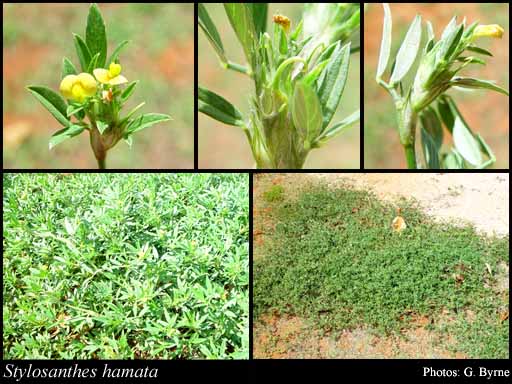
Scientific Description
Prostrate,spreading or scrambling, shrub, spindly shrub (broom-like). Stems terete, not spiny, hairy; pustules or glands absent. Leaves or phylloclades clearly present, compound, alternate, not continuous with stem, 15-35 mm long, glabrous, flat with flat margins; margins entire; tubercles absent, pinnately arranged, terminal leaflet present, stalked; pustules or glands absent. Stipules present and persistent to older leaves, 4-10 mm long, without glands, ribless. Bracteoles present and persistent, 2.5-5 mm long, hairy, not striate. Calyx 4-7.5 mm long, not accrescent, hairy, with simple hairs, ribless; pustules or glands absent. Corolla uniformly coloured, yellow; claws present; standard 4-5 mm long, glabrous, not auriculate, wings 3.5-4.5 mm long, auriculate, keel 3(-4.5) mm long, not beaked, not auriculate, glabrous. Stamens ten. Fruit dehiscent (a pod or follicle), constricted between the seeds, round in cross-section, beaked. Flowers in April, May, June, July, August, September, October and November. Occurs in the Northern and Eremaean Botanical Province, in the Pilbara, Carnarvon, Northern Kimberley, Victoria Bonaparte, Central Kimberley, Ord-Victorian-Plain and Dampierland IBRA regions.
Distribution
- IBRA Regions
- Carnarvon, Central Kimberley, Dampierland, Great Sandy Desert, Indian Tropical Islands, Northern Kimberley, Ord Victoria Plain, Pilbara, Victoria Bonaparte.
- IBRA Subregions
- Cape Range, Chichester, Fitzroy Trough, Hamersley, Keep, Mackay, Mitchell, Pentecost, Pindanland, Purnululu, Roebourne, South Kimberley Interzone.
- IMCRA Regions
- Kimberley.
- Local Government Areas (LGAs)
- Ashburton, Broome, Christmas Island, Cocos Islands, Derby-West Kimberley, East Pilbara, Exmouth, Halls Creek, Karratha, Port Hedland, Wyndham-East Kimberley.