- Reference
- Austral.Syst.Bot. 1:290 (1989)
- Conservation Code
- Not threatened
- Naturalised Status
- Native to Western Australia
- Name Status
- Current
Tree, 2-8 m high. Fl. green & pink, Jun to Oct. Skeletal soils over sandstone or quartzite. Rugged scarps, scree & low rocky hills.
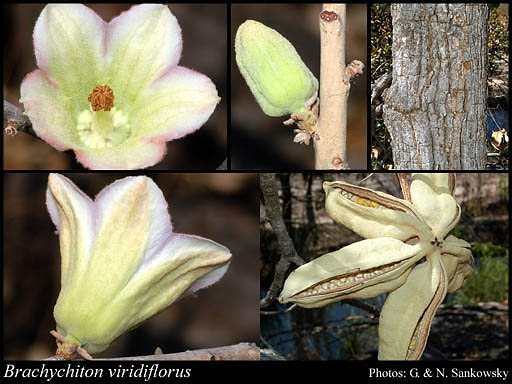
Scientific Description
Tree, with hairy stems. Leaves 45-120 mm long, 30-80 mm wide, not lobed; margins entire; hairy, with stellate hairswith scales absent, Sessile glands absent; stipules present but early deciduous (only visible on youngest leaves). Perianth of one whorl only (the visible whorl is a calyx, sometimes petaloid). Pedicel present, 3-5 mm long; indumentum present, with stellate hairs present, with scales absent. Epicalyx (extra segments or 'bracteoles' immediately below the calyx) absent. Calyx green or pink, 20-32 mm long, the lobes fused half or more of their length, Sessile glands absent, stellate hairs present, scales absent, Terminal appendages absent, number of ribs absent. Stamens many, united and arising from a staminal tube around the style; filaments absent (anthers sessile), indumentum absent (anthers glabrous). Staminodes absent, appendages absent. Ovary hairs or scales present, simple hairs absent, stellate hairs present, gland-tipped hairs absent; styles several, free and separate, arising from the summit of the ovary, 15 mm long, with five style branches or lobes, hairy for most of length, wing absent. Fruits indehiscent and splitting into sections (schizocarps), length-width ratio at least 1.5 times as long as wide, mericarps smooth, hairs and scales absent; apex rounded; prickles absent (except perhaps a terminal awn); terminal awns or spines absent; calyx deciduous before maturity, not accrescent; carpels 5; seeds per loculus 2-4 or ≥5. Flowering time June, July, August, September or October. Distribution Botanical Province Northern, IBRA Bioregion North Kimberley and Central Kimberley.
Distribution
- IBRA Regions
- Central Kimberley, Northern Kimberley.
- IBRA Subregions
- Berkeley, Mitchell, Pentecost.
- IMCRA Regions
- Kimberley.
- Local Government Areas (LGAs)
- Derby-West Kimberley, Wyndham-East Kimberley.