- Conservation Code
- Not threatened
- Naturalised Status
- Native to Western Australia
- Name Status
- Current
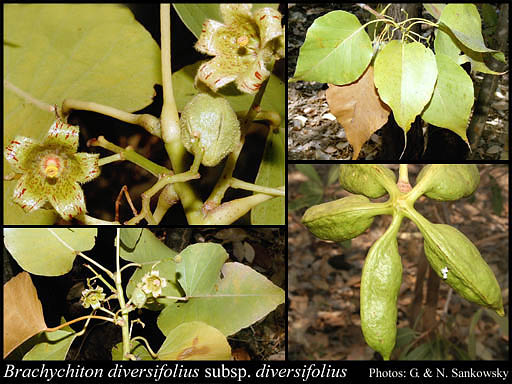
Tree, 3-18(-25) m high. Fl. green & yellow & red, May to Dec. Red sandy soils, basaltic soils, sandstone. Stony hills, along rivers.
Scientific Description
Tree, with hairy stems. Leaves 120-180 mm long, 55-105 mm wide, not lobed; margins entire; hairs and scales absent (leaves quite glabrous), Sessile glands absent; stipules present but early deciduous (only visible on youngest leaves). Perianth of one whorl only (the visible whorl is a calyx, sometimes petaloid). Pedicel present, 0.5-2 mm long; glabrous. Epicalyx (extra segments or 'bracteoles' immediately below the calyx) absent. Calyx green, 7-14 mm long, the lobes fused half or more of their length, Sessile glands absent, stellate hairs present, scales absent, Terminal appendages absent, number of ribs absent. Stamens many, united and arising from a staminal tube around the style; filaments present; anthers 0.6 mm long, indumentum absent (anthers glabrous). Staminodes present, appendages absent. Ovary hairs or scales present, simple hairs absent, stellate hairs present, gland-tipped hairs absent, 2 mm long, with five style branches or lobes, hairy for most of length, wing absent. Fruits indehiscent and splitting into sections (schizocarps), length-width ratio at least 1.5 times as long as wide, mericarps smooth, hairs and scales absent; apex rounded; prickles present, abundantly covering the fruit; terminal awns or spines absent; calyx deciduous before maturity, not accrescent; carpels 5; seeds per loculus 2-4 or ≥5. Flowering time May, June, July, August, September, October, November or December. Distribution Botanical Province Northern, IBRA Bioregion North Kimberley, Victoria Bonaparte, Central Kimberley, Dampierland and Ord-Victorian-Plain.
Distribution
- IBRA Regions
- Central Kimberley, Dampierland, Northern Kimberley, Ord Victoria Plain, Victoria Bonaparte.
- IBRA Subregions
- Berkeley, Fitzroy Trough, Keep, Mitchell, Mount Eliza, Pentecost, Pindanland, Purnululu.
- IMCRA Regions
- Canning, Kimberley.
- Local Government Areas (LGAs)
- Broome, Derby-West Kimberley, Halls Creek, Wyndham-East Kimberley.