- Conservation Code
-
Threatened
A taxon name retains its ‘Threatened’ status until a new name has been officially endorsed and appears in the Gazettal Notice.
- Naturalised Status
- Native to Western Australia
- Name Status
- Current
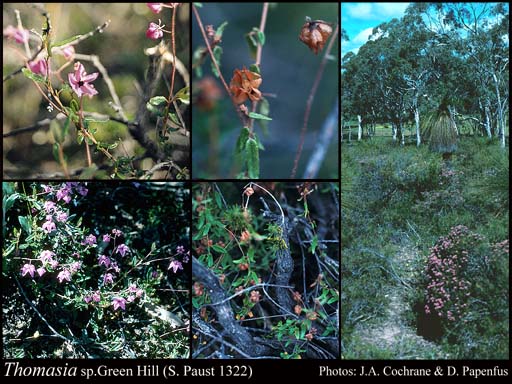
Multi-stemmed shrub. Fl. blue-purple, Oct. Rocky rise.
Scientific Description
Shrub, with hairy stems. Leaves 7-15 mm long, 4-5 mm wide, not lobed; margins entire; hairy, with stellate hairswith scales absent, Sessile glands absent; stipules present but early deciduous (only visible on youngest leaves), 3-6 mm long. Perianth of two whorls but the corolla reduced to small scales or tiny lobes at the base of the ovary. Pedicel present, 6-9 mm long; indumentum present, with stellate hairs present, with scales absent. Epicalyx (extra segments or 'bracteoles' immediately below the calyx) present, 2.4-5.5 mm long, the lobes free, indumentum present, stellate hairs presentwith scales absent, Sessile glands absent. Calyx blue or purple, 5-7 mm long, the lobes fused half or more of their length, Sessile glands absent, simple hairs (without tubercle bases) absent, stellate hairs present, tubercle-based simple hairs absent, gland-tipped hairs absent, scales absent, Terminal appendages absent, number of ribs present, one. Corolla 0.6-1 mm long, glabrous. Indumentum (outside) Sessile glands absent. Stamens five, free and inserted at the base of the ovary; filaments present, 1-1.5 mm long; anthers 2.8-3 mm long, indumentum absent (anthers glabrous). Staminodes absent, appendages absent. Ovary hairs or scales present, simple hairs absent, stellate hairs present, gland-tipped hairs absent; style 1, with a lobed or capitate stigma, 4-4.5 mm long, with one style branches or lobes, mostly glabrous, wing absent. Flowering time October. Distribution Botanical Province South-West, IBRA Bioregion Avon Wheatbelt and Jarrah Forest. Conservation Code Threatened (T).
Distribution
- IBRA Regions
- Avon Wheatbelt, Jarrah Forest.
- IBRA Subregions
- Katanning, Northern Jarrah Forest.
- Local Government Areas (LGAs)
- Victoria Plains.