- Reference
- Lehm., Pl.Preiss. [J.G.C.Lehmann] 2:20 (1846)
- Conservation Code
- Not threatened
- Naturalised Status
- Native to Western Australia
- Name Status
- Current
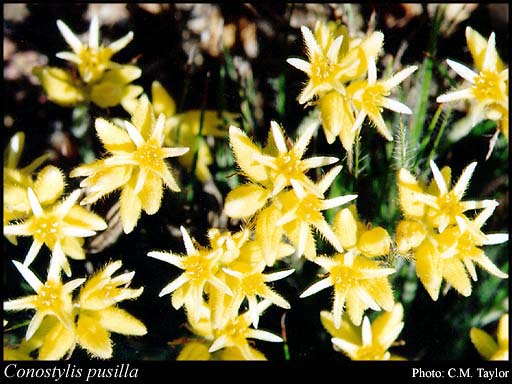
Rhizomatous, tufted perennial, grass-like or herb, 0.02-0.06 m high. Fl. yellow, Sep to Oct. Sandy loam, clay, sand.
Scientific Description
Leaves flat, 25-100 mm long, 0.5-1 mm wide; bristles or hairs on the leaf margin present, 10-32 mm long, simple, without any side branches, straight and rigid, angled towards the leaf apex; hairs on the surface of the leaf absent (leaf surfaces glabrous). Scape present, hairy, 35-110 mm long. Inflorescence subtended by a bract 8-10 mm long, with several flowers; floral bracts 4-5 mm long; pedicels present, 1-1.5 mm long; flowers 4.5-14 mm long. Perianth hairy, radially symmetrical, uniformly coloured, yellow, with six more or less equal tepals, the inner segments 5-5.5 mm long. Stamens six, in two levels alternating; filaments 1.5-2.5 mm long; anther 2-2.2 mm long, without an appendage. Style 5.5-7 mm long. Flowers in September or October. Occurs in the Avon Wheatbelt, Jarrah Forest, Mallee and Esperance IBRA bioregion(s), of the South-west Botanical Province.
Distribution
- IBRA Regions
- Avon Wheatbelt, Esperance Plains, Jarrah Forest, Mallee.
- IBRA Subregions
- Fitzgerald, Katanning, Merredin, Northern Jarrah Forest, Southern Jarrah Forest, Western Mallee.
- Local Government Areas (LGAs)
- Albany, Armadale, Beverley, Boddington, Boyup Brook, Bridgetown-Greenbushes, Brookton, Broomehill-Tambellup, Collie, Cranbrook, Cuballing, Denmark, Dumbleyung, Gnowangerup, Harvey, Jerramungup, Katanning, Kent, Kojonup, Manjimup, Murray, Narrogin, Northam, Plantagenet, Quairading, Serpentine-Jarrahdale, Toodyay, Wagin, Wandering, West Arthur, Williams, Woodanilling.