- Reference
- Nuytsia 12(1):118 (1998)
- Conservation Code
- Not threatened
- Naturalised Status
- Native to Western Australia
- Name Status
- Current
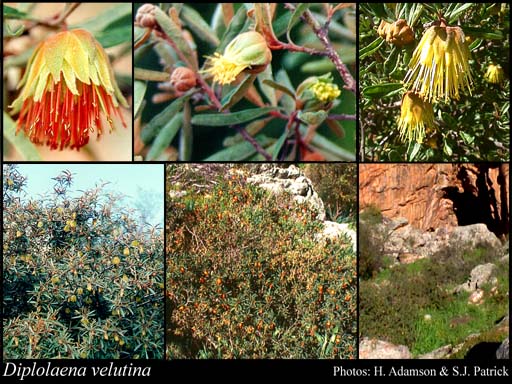
Spreading shrub, 0.3-1.8(-2.5) m high, leaves narrowly oblong-cuneate, often conduplicate, margin flat or slightly recurved. Fl. yellow-green/red-orange, Feb or May to Nov. Sandy soils, gravel. Granite outcrops, rocks & hills.
Scientific Description
Shrub, spines absent; branchlets smooth, without distinct raised glands, +/- cylindrical in cross-section, covered in hairs or scales, the hairs stellate (star-shaped). Leaves alternate, simple, 10-30 mm long, 4-10 mm wide, flat, the margins flat, smooth, without distinct raised glands, covered in hairs or scales, with stellate (star shaped) hairs; stipular excrescences absent. Flowers in a distinct head surrounded by bracts, the outer bracts 7-10 mm long; pedicels 4-5 mm long; calyx minute or absent, smooth, without distinct raised glands; corolla red, yellow, green or orange, petals five, 8-10 mm long, imbricate (overlapping), free, hairy on the surfaces; stamens numerous (more than twice as many as petals), 10-20 mm long, smooth, hairy; anthers 1-1.3 mm long, without an appendage. Flowers in February, May, June, July, August, September, October and November. Occurs in the South-West Botanical Province, in the Avon Wheatbelt, Mallee, Swan Coastal Plain and Geraldton IBRA region(s).
Distribution
- IBRA Regions
- Avon Wheatbelt, Geraldton Sandplains, Mallee, Swan Coastal Plain.
- IBRA Subregions
- Dandaragan Plateau, Katanning, Lesueur Sandplain, Merredin, Western Mallee.
- Local Government Areas (LGAs)
- Bruce Rock, Coorow, Corrigin, Dandaragan, Dowerin, Dumbleyung, Kellerberrin, Kulin, Merredin, Moora, Mount Marshall, Mukinbudin, Nungarin, Quairading, Tammin, Trayning, Victoria Plains, Westonia, Wongan-Ballidu, Wyalkatchem, Yilgarn.