- Reference
- Fl.Australia 16:479 (1995)
- Conservation Code
- Priority Three
- Naturalised Status
- Native to Western Australia
- Name Status
- Current
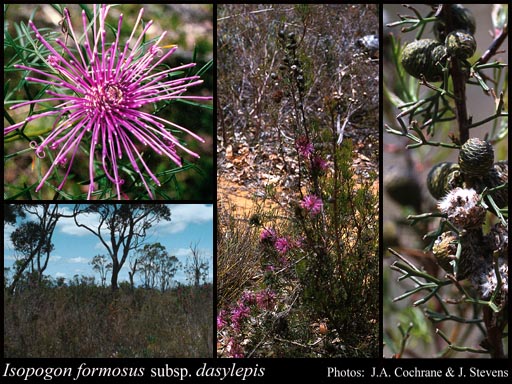
Low, bushy or slender, upright, non-lignotuberous shrub, 0.2-2 m high. Fl. pink-purple/red, Jun to Dec. Sand, sandy clay, gravelly sandy soils over laterite. Often swampy areas.
Scientific Description
Shrubs, 0.5-1.5 m high; branchlets glabrous. Leaves alternate, 25-70 mm long, glabrous; lamina terete or flat, once divided or twice or more divided, pinnately divided or tripartitely divided, entire or divided to the midrib, with (2-)7-12(-48) points or lobes; distance from base of leaf to lowest lobe 15-30 mm. Inflorescences not viscid, red or pink. Perianth 18-26 mm long, hairy, the limb apex hairy at the apex only; pistil 20-27 mm long; pollen presenter not fusiform, hairy, 4-5 mm long, the brush 1.5-2 mm long. Cone with deciduous scales, 12-20 mm long. Flowers in June, July, August, September, October, November or December. Occurs in the South-west (SW) Botanical Province(s), in the Swan Coastal Plain (SWA), Jarrah Forest (JF) or Warren (WAR) IBRA subregion(s). : Conservation code Priority Three (P3).
Distribution
- IBRA Regions
- Jarrah Forest, Swan Coastal Plain, Warren.
- IBRA Subregions
- Perth, Southern Jarrah Forest, Warren.
- Local Government Areas (LGAs)
- Augusta Margaret River, Busselton, Capel, Donnybrook-Balingup, Nannup.