- Conservation Code
- Not threatened
- Naturalised Status
- Native to Western Australia
- Name Status
- Current
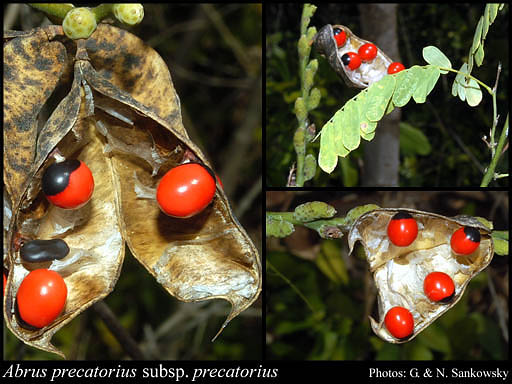
Climber, seeds are extremely toxic. Fl. purple-violet, Jan or Mar to Jul or Nov to Dec. Sand, sandstone, limestone, basalt. Coastal areas, creeklines.
Scientific Description
Genus Abrus. Form prostrate,spreading or scrambling. Stems Indumentum hairy, Pustules or glands absent, Cross section terete, Spiny on any part of plant not spiny. Leaves or phylloclades Presence clearly present, Position alternate, Leaves compound, Leaves or phylloclade continuous with stem not continuous with stem, Cross section of leaf or leaflet flat with flat margins, Margins of leaf or leaflet entire, Pustules or glands absent. Length Leaf length 65-105. Leaflets Number more than three, Number of leaflets (if more than three) 19-37, Arrangement pinnately arranged. Terminal leaflet Presence present, Stalk stalked. Indumentum Presence hairy, Type simple. Stipules Presence present and persistent to older leaves, Glands without glands, Ribs ribless. Length Stipule length 1.5-3. Bracteoles Presence present and persistent. Calyx Pustules or glands absent, Ribs ribless, Enlarged in fruit not accrescent. Length Calyx length 2-3. Indumentum Presence hairy, Type with simple hairs. Corolla Colour patterning multicoloured, Colour (when multicoloured - choose one colour) pink, Colour (when multicoloured - choose a second colour) purple, Petal claws ( the narrow base of the petals present. Indumentum Presence absent. Standard Indumentum glabrous, Auricles not auriculate. Length Standard length 8-10. Wings Auricles not auriculate. Length Wing length 7-8. Stamens Number nine. Filaments Fusion united in an open sheath. Fruit Constriction constricted between the seeds, Compression flat or compressed, Placement sessile or subsessile, Beak not beaked. Length Fruit length 35-40. Width Fruit width 13-15. Indumentum Presence hairy, Indumentum type with simple hairs. Flowering time January, March, April, May, June, July, November or December. Distribution Botanical Province Northern, IBRA Bioregion Northern Kimberley, Victoria Bonaparte, Central Kimberley, Ord-Victorian-Plain or Dampierland.
Distribution
- IBRA Regions
- Central Kimberley, Dampierland, Darwin Coastal, Northern Kimberley, Ord Victoria Plain, Victoria Bonaparte.
- IBRA Subregions
- Berkeley, Fitzroy Trough, Keep, Mitchell, Mount Eliza, Pindanland, Purnululu.
- IMCRA Regions
- Cambridge-Bonaparte, Canning, Kimberley.
- Local Government Areas (LGAs)
- Broome, Derby-West Kimberley, Halls Creek, Wyndham-East Kimberley.