- Reference
- Nuytsia 12(2):229-230 (1998)
- Conservation Code
- Priority Three
- Naturalised Status
- Native to Western Australia
- Name Status
- Current
Perennial, tufted clonal herb, 0.05-0.08 m high, leaves spathulate, 2-6 mm wide; flowering stalks 0.9-3 cm long, usually just shorter than leaves. Fl. white-cream, Nov to Dec. Sandy, clay or loamy soils over laterite. Eucalypt woodland over low heath.
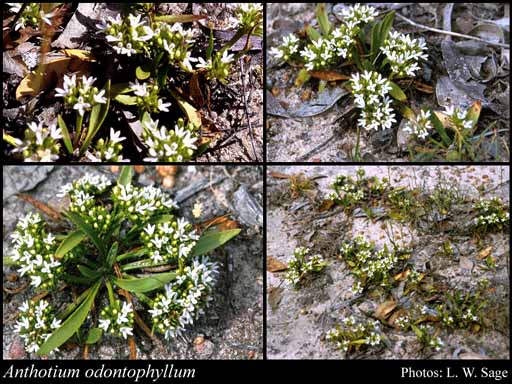
Scientific Description
Stems unribbed. Leaves flat, 20-70 mm long, 2-9 mm wide, Indumentum absent (leaves glabrous); margins entire. Bracteoles present, 2.5-3 mm long, glabrous. Pedicel absent (flowers sessile), glabrous. Calyx lobes present, Calyx length 3-4 mm long, glabrous. Corolla white, 7-9 mm long, auriculate, not spurred, hairy or glabrous on the outside, with sparse, glandular hairs, hairy on the inside; central lobes 3-4.5 mm long, with wings; outer lobes 2.8-4.5 mm long, wing present on one side only, 0.2 mm wide. Anthers connate. Ovary inferior, not gibbose; style 3.5-4.4 mm long, glabrous; indusium single, glabrous; ovules more than two. Flowers in November and December. Occurs in the Avon Wheatbelt (AW) and Jarrah Forest (JF) IBRA Region(s), of the South West (SW) Botanical Province. Conservation Code: Conservation code Priority Three (P3).
Distribution
- IBRA Regions
- Avon Wheatbelt, Jarrah Forest.
- IBRA Subregions
- Katanning, Northern Jarrah Forest.
- Local Government Areas (LGAs)
- Narrogin, Pingelly, Wagin, Williams.