This name is not current. Find out more information on related names.
- Reference
- Ann.Soc.Linn.Lyon Ser.2,17:145 (1869)
- Conservation Code
- Not threatened
- Naturalised Status
- Alien to Western Australia
- Name Status
- Not Current
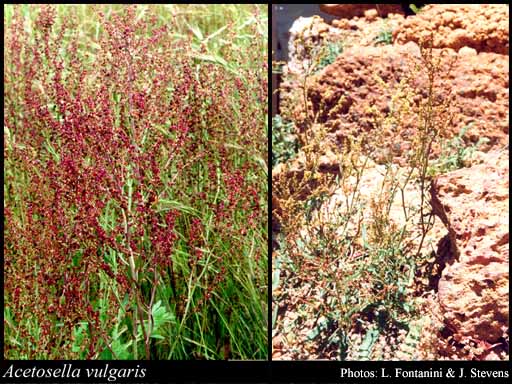
Erect or ascending perennial, herb, 0.1-0.5 m high. Fl. red, Jul to Dec. Sandy or loamy soils. Disturbed areas, road verges.
Management Notes (for the Swan NRM Region)
Alternative Names. Sheep's Sorrel, Field Sorrel.
General Biology. Growth form. Herb. Life form. Perennial. Reproduction. Primarily seed, also root fragments. Dispersal. Wind, water, animal, soil. Toxicity. Suspected of being poisonous to livestock, particularly sheep. Seedbank persistence. Long, 5+ years.
Notes. Widespread and common species especially in temperate regions. Found in a wide range of habitats but especially in open/disturbed areas. Naturalised throughout North America, and is listed as noxious in many US states.Reported to invade a broad range of habitats and outcompete native plant species especially annuals. Spreads vigorously from root buds and wind-dispersed seeds. Seldom grazed and may be locally dominant in temperate pastures.
Additional information. Origin. Europe. History of use/introduction. Food.
Suggested method of management and control. Has a dense root system that makes manual removal dificult. Roots left on the soil surface can often go on to produce new plants, so if handremoving ensure all parts are carefully disposed of. Alternatively, spot spray 0.5% glyphosate or metsulfuron methyl 0.2 g/10 L + Pulse® . Read the manufacturers' labels and material safety data sheets before using herbicides. For further information consult the Australian Pesticides and Veterinary Medicines Authority to determine the status of permits for your situation or state.
Management Calendar
| Calendar Type | Jan | Feb | Mar | Apr | May | Jun | Jul | Aug | Sep | Oct | Nov | Dec | Comments |
|---|---|---|---|---|---|---|---|---|---|---|---|---|---|
| Herbicide Treatment | Y | Y | Y | Y | |||||||||
| Germination | Y | Y | Y | Y | |||||||||
| Active Growth | Y | Y | Y | Y | Y | ||||||||
| Flowering | Y | Y | Y | Y | Y | ||||||||
| Fruiting | Y | Y | Y | Y | |||||||||
| Manual Removal | Y | Y | Y | Y |
Legend: Y = Yes, regularly, O = Occasionally, U = Uncertain, referred by others but not confirmed.
References
- Brown, K. & Brooks, K. (2002) Bushland Weeds: A Practical Guide to their Management. Environmental Weeds Action Network, Greenwood.
- Frey, M., Soong, J. & Dishy, S. (2008) Identifying control techniques for Rumex acetosella in the Presidio of San Francisco (California). Ecological Restoration, 26 (2): 109-111.
- Granstrom, A. (1987) Seed viability of fourteen species during five years of storage in forest soil. Journal of Ecology, 75: 321-331.
- Harden, G.J. (ed.) (1990-93) Flora of New South Wales Vols. 1 to 4. New South Wales University Press, Kensington.
- Hussey, B.M.J., Keighery, G.J., Dodd, J., Lloyd, S.G. & Cousens, R.D. (2007) Western Weeds. A guide to the weeds of Western Australia. 2nd Edition. The Plant Protection Society of Western Australia, Victoria Park.
- Moore, J.H. & Wheeler, J. (2008) Southern weeds and their control. DAFWA Bulletin 4744.
- Parsons, W.T. & Cuthbertson, E.G. (2001) Noxious weeds of Australia. 2nd Edition. CSIRO Publishing, Collingwood.
- Pickering, C.M., Kirkwood, A. & Arthur, M. (2008) Habitat and sex specific differences in the dioecious weed Acetosella vulgaris (Polygonaceae). Austral Ecology, 28 (4): 396 - 403.
- USDA, ARS, National Genetic Resources Program (2009) Germplasm Resources Information Network - (GRIN). National Germplasm Resources Laboratory, Beltsville, Maryland. URL: https://npgsweb.ars-grin.gov/gringlobal/taxon/taxonomysimple.aspx - Accessed October 2009.