- Reference
- J.Bot. 72:281 (1934)
- Conservation Code
- Not threatened
- Naturalised Status
- Native to Western Australia
- Name Status
- Current
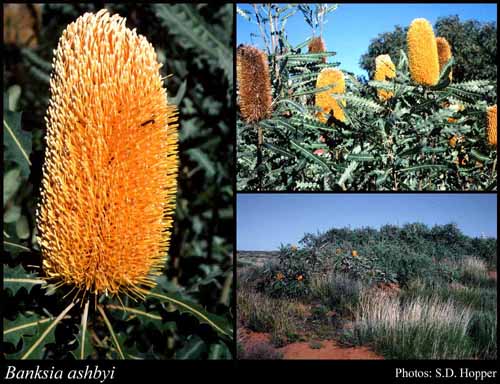
Small tree or shrub, 1-8 m high, no lignotuber or lignotuber present. Fl. yellow-orange, Feb to Mar or May or Jul to Sep or Dec. Red, yellow or white sand. Coastal or red sand dunes, sandplains.
Scientific Description
Trees or Shrubs, 4-7 m high; branchlets glabrous or hairy. Leaves petiolate, alternate, 170-330 mm long, 25-35 mm wide, hairy; petiole 25-50 mm long; lamina flat, more or less the same width throughout, once divided, pinnately divided, shallowly divided, teeth pointing outwards, with 17-20 lobes on each side, the margins flat. Inflorescences tomentose (with matted or tangled, soft, woolly hairs), yellow or orange; innermost bracts 9-12 mm long, hairy. Perianth 15-20 mm long, hairy, all over, limb apex pubescent (with soft, straight, erect hairs), without awns; pistil 28-37 mm long, straight or curved, style glabrous. Follicles hairy, tomentose (with matted or tangled, soft, woolly hairs), elliptic or orbicular. Flowers in February, March, April, May, June, July, August, September or December. Occurs in the Eremaean (ER) or South-west (SW) Botanical Province(s), in the Carnarvon (CAR), Yalgoo (YAL), Geraldton Sandplains (GS) or Avon Wheatbelt (AW) IBRA subregion(s).
Distribution
- IBRA Regions
- Avon Wheatbelt, Carnarvon, Geraldton Sandplains, Yalgoo.
- IBRA Subregions
- Cape Range, Edel, Geraldton Hills, Lesueur Sandplain, Merredin, Wooramel.
- IMCRA Regions
- Ningaloo, Shark Bay.
- Local Government Areas (LGAs)
- Carnarvon, Chapman Valley, Coorow, Exmouth, Greater Geraldton, Northampton, Shark Bay, Three Springs.