- Reference
- Canad.J.Bot. 69:2694-2695,Figs 9-11,42-43 (1991)
- Conservation Code
- Priority Three
- Naturalised Status
- Native to Western Australia
- Name Status
- Current
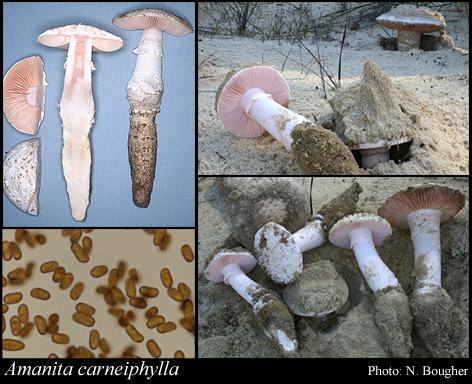
Scientific Description
Amanita carneiphylla - the ‘Pink-gilled Amanita’ - is distinctive by virtue of its pink gills, white warts on the cap, and long rooting stem. Fruit bodies often remain mostly embedded in the soil at maturity.
Characteristic Features (i) Pastel pink gills (near Methuen 8A2 to 9A2) which dull (near Methuen 9B2) but remain pink in old age; (ii) Finely striate pendulous persistent superior annulus; (iv) Multiple belts of membranous tissue on lower stem; (iv) Fleshy solid pale pink flesh unchanging when cut or bruised; (v) Fusoid, rooting stem; (vi) conical to blunt white warts (up to 2mm tall) crowded on cap.
Habitat Deeply rooting in sandy soil, solitary or in small scattered groups
Distribution
- IBRA Regions
- Avon Wheatbelt, Jarrah Forest, Swan Coastal Plain.
- IBRA Subregions
- Katanning, Northern Jarrah Forest, Perth, Southern Jarrah Forest.
- Local Government Areas (LGAs)
- Cuballing, Denmark, Joondalup, Melville, Serpentine-Jarrahdale, Swan, Wandering, Wanneroo, Williams.