- Reference
- Hooker's J.Bot.Kew Gard.Misc. 7:120 (1855)
- Conservation Code
- Not threatened
- Naturalised Status
- Native to Western Australia
- Name Status
- Current
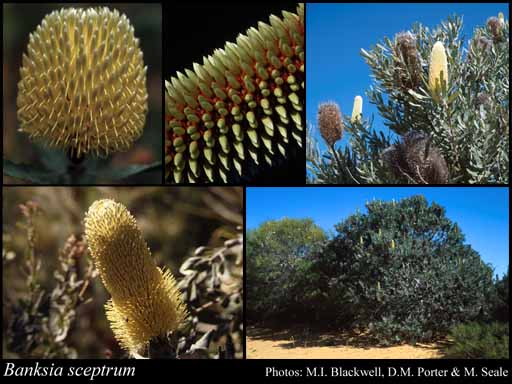
Much-branched, lignotuberous shrub, 1.5-5 m high. Fl. yellow, Nov to Dec or Jan. Yellow or pale red-brown sand. Dunes & in swales.
Scientific Description
Trees or Shrubs, 1.5-5 m high; branchlets glabrous or hairy. Leaves petiolate, alternate, 40-105 mm long, 12-20 mm wide, hairy; petiole 5-15 mm long; lamina flat, more or less the same width throughout, once divided, pinnately divided, shallowly divided, teeth pointing outwards, with 10-17 lobes on each side, the margins flat. Inflorescences tomentose (with matted or tangled, soft, woolly hairs), yellow, hairy. Perianth 27-30 mm long, hairy, all over, limb apex hirsute (with long, rough and coarse hairs), without awns; pistil 40-42 mm long, curved, style hairy. Follicles hairy, pubescent (with soft, straight, erect hairs), elliptic, 15-25 mm long. Flowers in January, November or December. Occurs in the Eremaean (ER) or South-west (SW) Botanical Province(s), in the Yalgoo (YAL), Geraldton Sandplains (GS) or Avon Wheatbelt (AW) IBRA subregion(s).
Distribution
- IBRA Regions
- Avon Wheatbelt, Geraldton Sandplains, Yalgoo.
- IBRA Subregions
- Edel, Geraldton Hills, Merredin.
- Local Government Areas (LGAs)
- Greater Geraldton, Northampton, Shark Bay.