This name is not current. Find out more information on related names.
- Reference
- Nuytsia 12(2):287 (1998)
- Conservation Code
- Not threatened
- Naturalised Status
- Native to Western Australia
- Name Status
- Not Current
Shrub, 0.4-1.5 m high. Fl. white, Jan or Mar or Jun or Aug to Oct or Dec. Lateritic soils. Gravelly hillsides & plains.
Scientific Description
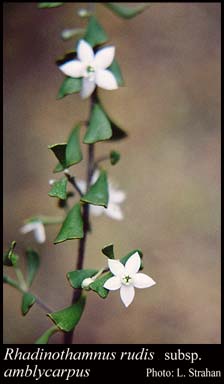
Shrub, spines absent; branchlets smooth, without distinct raised glands, winged or strongly angled in cross-section, glabrous. Leaves alternate, simple, 10-15 mm long, 2-5 mm wide, flat, the margins flat, smooth, without distinct raised glands, glabrous; stipular excrescences absent. Flowers axillary, solitary; pedicels 5-8 mm long; calyx present, 0.5-1 mm long, smooth, without distinct raised glands, covered in hairs or scales; corolla white or cream, petals five, 4-6 mm long, imbricate (overlapping), free, lepidote (with scales); stamens twice as many as petals, 3-4 mm long, smooth, glabrous; anthers 0.4-0.5 mm long, without an appendage. Flowers in January, March, June, August, September, October and December. Occurs in the South-West Botanical Province, in the Jarrah Forest, Mallee and Esperance IBRA region(s).