- Reference
- Bot.Jahrb.Syst. 35:141-142 (1904)
- Conservation Code
- Priority Three
- Naturalised Status
- Native to Western Australia
- Name Status
- Current
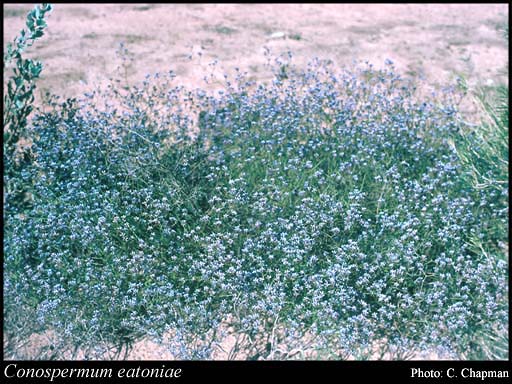
Spreading, intricately branched shrub, 0.3-1 m high. Fl. blue, Aug to Oct. Deep white sand, sandy clay loam.
Scientific Description
Shrubs, 0.5-1 m high; branchlets glabrous. Leaves alternate, 150-300 mm long; lamina flat, more or less the same width throughout, twice or more divided, divided to the midrib, erect. Inflorescences without leaves, the flowers dispersed singly, blue, hairy; floral bracts 1.8-3 mm long, hairy. Perianth 5-9 mm long, irregular, glabrous; upper lip 2.5-5 mm long, glabrous; lower lip 1.5-2 mm long, glabrous. Nut 1-2 mm long. Flowers in August, September or October. Occurs in the South-west (SW) Botanical Province(s), in the Geraldton Sandplains (GS) or Avon Wheatbelt (AW) IBRA subregion(s). : Conservation code Priority Three (P3).
Distribution
- IBRA Regions
- Avon Wheatbelt, Geraldton Sandplains.
- IBRA Subregions
- Katanning, Lesueur Sandplain, Merredin.
- Local Government Areas (LGAs)
- Brookton, Coorow, Cunderdin, Dowerin, Goomalling, Kellerberrin, Merredin, Moora, Quairading, Tammin.