- Conservation Code
-
Threatened
A taxon name retains its ‘Threatened’ status until a new name has been officially endorsed and appears in the Gazettal Notice.
- Naturalised Status
- Native to Western Australia
- Name Status
- Current
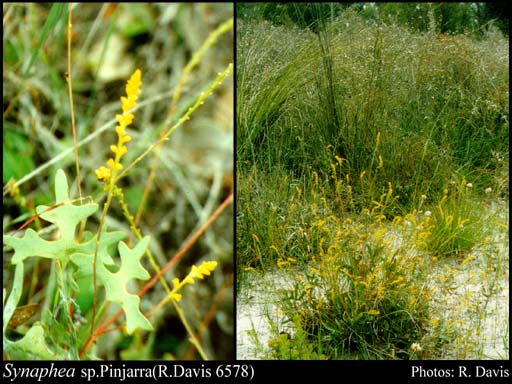
Compact shrub, to 0.4 m high, to 0.5 m wide. Fl. yellow, Sep. Grey clayey sand. Swamp.
Scientific Description
Shrubs; branchlets glabrous. Leaves alternate, 115-190 mm long, glabrous; petiole glabrous; lamina flat, once divided or twice or more divided, pinnately divided or tripartitely divided, deeply divided or divided to the midrib; distance from base of leaf to lowest lobe 70-110 mm; terminal leaf lobe 6-10 mm long, 3-5 mm wide; lowest lobes 20-65 mm long. Inflorescences yellow; scape 200-710 mm long; floral bracts 1-1.5 mm long. Perianth 4-5.5 mm long, glabrous; adaxial tepal 4-5.5 mm long; abaxial tepal 3.5-4 mm long; ovary hairy, style glabrous; style including stigmatic disc 3-3.5 mm long, horned; stigma 1-1.2 mm long, 0.6-0.8 mm wide. Flowers in September. Occurs in the in the Swan Coastal Plain (SWA) IBRA subregion(s). : Conservation code Threatened (T).
Distribution
- IBRA Regions
- Swan Coastal Plain.
- IBRA Subregions
- Perth.
- Local Government Areas (LGAs)
- Murray.