- Reference
- Nuytsia 13(1):255-257, Fig.1 (1999)
- Conservation Code
- Priority Two
- Naturalised Status
- Native to Western Australia
- Name Status
- Current
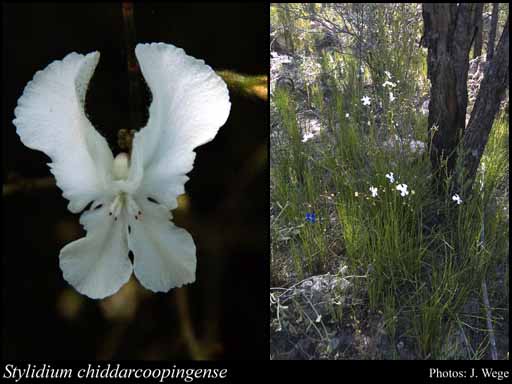
Caespitose perennial, herb, 0.2-0.45 m high, Leaves tufted, linear, 12-26 cm long, 0.5-0.9 mm wide, apex acute to mucronate, margin involute, glabrous. Membraneous scale leaves present at base of mature leaves. Scape glandular throughout. Inflorescence paniculate. Fl. white, Sep. Clayey sand, granite. Outcrops, slopes of kaolinite breakaways. Shrubland with Allocasarina and Callitris.
Distribution
- IBRA Regions
- Avon Wheatbelt.
- IBRA Subregions
- Merredin.
- Local Government Areas (LGAs)
- Westonia.
Nuytsia Journal Articles
Stylidium chiddarcoopingense (Stylidiaceae), a new species from south-west Western Australia
LOWRIE, A., COATES, D.J. AND KENNEALLY, K.F., Nuytsia 13 (1): 255–257 (1999)
Stylidium chiddarcoopingense (Stylidiaceae) is a new species of triggerplant endemic to south-west Western Australia. It is a member of the Stylidium caricifolium complex, in which seven species are now recognized. The other six species were described and illustrated in Lowrie et al. (1998). All members of the Stylidium caricifolium complex belong in subgenus Tolypangium Endl., section Squamosae Benth. (Mildbraed 1908).