- Reference
- Nuytsia 14(3):372-373,Fig.1H-K (2002)
- Conservation Code
-
Threatened
A taxon name retains its ‘Threatened’ status until a new name has been officially endorsed and appears in the Gazettal Notice.
- Naturalised Status
- Native to Western Australia
- Name Status
- Current
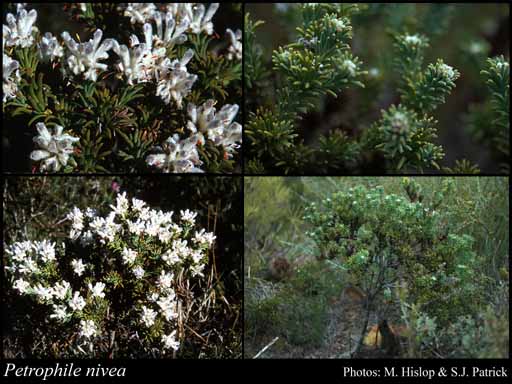
Erect, rigid shrub, to 0.6 m high. Fl. white, May or Jul. Dry bare white sand over gravel over laterite. Uplands.
Scientific Description
Shrubs, 0.5-1 m high; branchlets glabrous. Leaves alternate, 8-15 mm long, 1.5-2 mm wide, glabrous; lamina terete, entire, straight or curved, scabrous, apex pungent, 0.7-1 mm long. Inflorescences not viscid, white or cream. Perianth 18-20 mm long, hairy, the limb apex hairy all over; pistil 18-20 mm long; pollen presenter not fusiform, hairy, 2-2.5 mm long, the brush 1-1.3 mm long. Cone with persistent scales. Flowers in May, June or July. Occurs in the South-west (SW) Botanical Province(s), in the Geraldton Sandplains (GS) IBRA subregion(s). : Conservation code Threatened (T).
Distribution
- IBRA Regions
- Geraldton Sandplains.
- IBRA Subregions
- Lesueur Sandplain.
- Local Government Areas (LGAs)
- Coorow.