- Reference
- J.Linn.Soc.,Bot. 34:221 (1898)
- Conservation Code
- Not threatened
- Naturalised Status
- Native to Western Australia
- Name Status
- Current
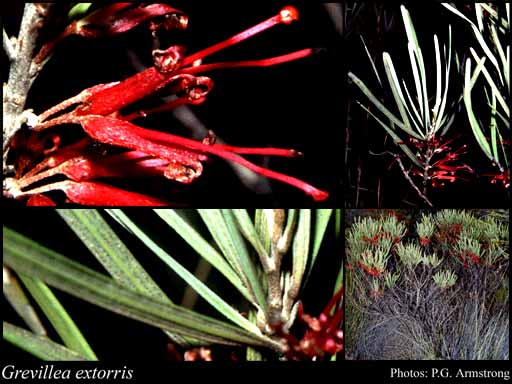
Spreading, bushy shrub, 1-2.5(-3) m high. Fl. red-pink, May to Oct. Rocky soils on laterite or granite, red loam. Rocky situations, hillslopes, creek banks.
Scientific Description
Shrubs, 1-2 m high; branchlets hairy, not glaucous. Leaves alternate, 60-110 mm long, 1-3 mm wide, hairy, on the adaxial or abaxial surface, the hairs straight; lamina flat, more or less the same width throughout, entire, the margins recurved or revolute, exposing the lower surface of the leaf blade or enclosing the lower surface of the leaf blade, forming a groove either side of the midvein. Inflorescences axillary, yellow, red or pink; pedicels 3-5 mm long. Perianth 9-12 mm long; tepals some joined and some free after flower opens, hairy, simple-hairy; ovary hairy, stipitate, the stipe 2-3.5 mm long; pistil 20-35 mm long, yellow or red, pollen presenter oblique, style glabrous. Follicles hairy, not viscid, dehiscent, 11-15 mm long. Flowers in April, May, June, July, August or September. Occurs in the Eremaean (ER) or South-west (SW) Botanical Province(s), in the Yalgoo (YAL), Murchison (MUR), Great Victoria Desert (GVD), Coolgardie (COO) or Avon Wheatbelt (AW) IBRA subregion(s).
Distribution
- IBRA Regions
- Avon Wheatbelt, Coolgardie, Great Victoria Desert, Murchison, Yalgoo.
- IBRA Subregions
- Eastern Murchison, Merredin, Shield, Southern Cross, Tallering, Western Murchison.
- Local Government Areas (LGAs)
- Cue, Greater Geraldton, Laverton, Leonora, Menzies, Mingenew, Morawa, Mount Magnet, Mount Marshall, Murchison, Perenjori, Sandstone, Three Springs, Wiluna, Yalgoo, Yilgarn.