- Reference
- Lehm., Pl.Preiss. [J.G.C.Lehmann] 1:543 (1845)
- Conservation Code
- Not threatened
- Naturalised Status
- Native to Western Australia
- Name Status
- Current
Erect to prostrate shrub, 0.3-3(-4) m high, up to 4 m wide. Fl. pink-red/cream-yellow, Jan to Mar or Jun or Aug to Dec. Sandy to clay, often lateritic or calcareous soils.
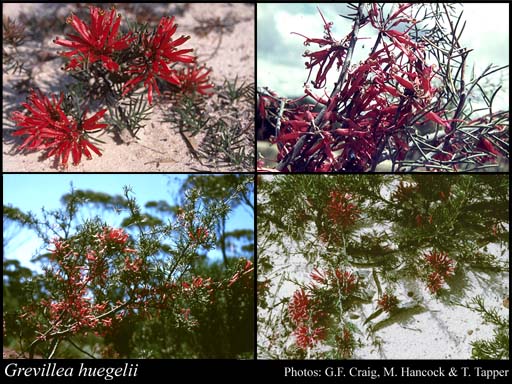
Scientific Description
Shrubs, 0.5-3 m high; branchlets glabrous or hairy, not glaucous. Leaves alternate, 10-60 mm long, hairy or glabrous, on the adaxial or abaxial surface, the hairs straight; lamina flat, once divided, pinnately divided, divided to the midrib; lobes 5-40 mm long, 0.5-2 mm wide, the margins revolute, exposing the lower surface of the leaf blade or enclosing the lower surface of the leaf blade, forming a groove either side of the midvein. Inflorescences axillary or terminal, yellow, orange or red; pedicels 6-10 mm long. Perianth 17-22 mm long; tepals all free after flower opens, hairy, simple-hairy; ovary glabrous, stipitate, the stipe 5-10 mm long; pistil 19.5-28.5 mm long, yellow or red, pollen presenter oblique, style glabrous. Follicles glabrous, not viscid, dehiscent, 10-12 mm long. Flowers in July, August, September, October, November or December. Occurs in the Eremaean (ER) or South-west (SW) Botanical Province(s), in the Great Victoria Desert (GVD), Coolgardie (COO), Avon Wheatbelt (AW), Mallee (MAL) or Esperance Plains (ESP) IBRA subregion(s).
Distribution
- IBRA Regions
- Avon Wheatbelt, Coolgardie, Esperance Plains, Great Victoria Desert, Jarrah Forest, Mallee.
- IBRA Subregions
- Eastern Goldfield, Eastern Mallee, Fitzgerald, Katanning, Mardabilla, Merredin, Northern Jarrah Forest, Recherche, Shield, Southern Cross, Western Mallee.
- Local Government Areas (LGAs)
- Albany, Beverley, Bruce Rock, Coolgardie, Corrigin, Cranbrook, Cunderdin, Dalwallinu, Dowerin, Dumbleyung, Dundas, Esperance, Gnowangerup, Goomalling, Jerramungup, Kalgoorlie-Boulder, Kellerberrin, Kent, Kondinin, Koorda, Kulin, Lake Grace, Merredin, Moora, Mount Marshall, Narembeen, Narrogin, Northam, Nungarin, Pingelly, Plantagenet, Ravensthorpe, Tammin, Trayning, Wagin, Westonia, Wickepin, Wongan-Ballidu, Wyalkatchem, Yilgarn.