- Reference
- W.T.Aiton, Hort.Kew. [W. Aiton] Ed.2.3:16 (1811)
- Conservation Code
- Not threatened
- Naturalised Status
- Native to Western Australia
- Name Status
- Current
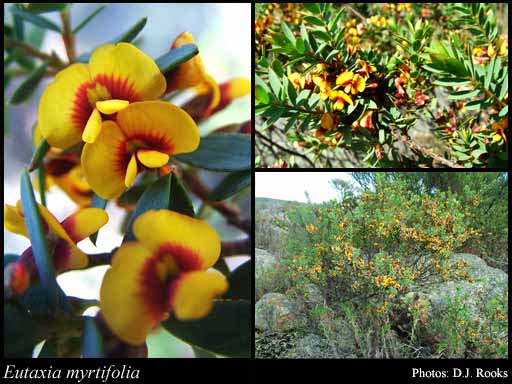
Prostrate to erect shrub, to 2 m high. Fl. orange-yellow/red, Feb or May or Jul to Dec. Black/white peaty sand, sandy clay loam, gravel, granite, quartzite. Rocky outcrops, moss swards, coastal wetlands, swamps, creekbanks.
Scientific Description
Genus Aenictophyton or Eutaxia. Form prostrate,spreading or scrambling. Habit shrub, spindly shrub (broom-like). Stems Indumentum glabrous, Pustules or glands absent, Striation (stems ribbed) not striate, Cross section terete, Spiny on any part of plant not spiny. Leaves or phylloclades Presence clearly present, Position opposite, Leaves simple, Leaves or phylloclade continuous with stem not continuous with stem, Cross section of leaf or leaflet flat with flat margins or flat with recurved margins, Margins of leaf or leaflet entire, Tuberculate tubercles absent, Pustules or glands absent. Length Leaf length 10-25. Width (entire leaves only) Leaf width 2-5. Scale leaves length mm long NaN (?). Indumentum Presence glabrous. Stipules Presence apparently absent even from the youngest leaves or present and persistent to older leaves, Glands with glands (?) or without glands (?), Ribs ribbed (?) or ribless (?). Length Stipule length NaN (?). Bracteoles Presence present and persistent, Indumentum glabrous, Striation not striate. Length Bracteole length 0.7-1. Pedicel Presence present, Indumentum glabrous. Length Pedicel length 4-5. Calyx Pustules or glands absent, Ribs ribbed, Enlarged in fruit not accrescent. Length Calyx length 5-6.4. Indumentum Presence glabrous. Corolla Colour patterning multicoloured, Colour (when multicoloured - choose one colour) yellow, red or orange, Colour (when multicoloured - choose a second colour) yellow, red or orange, Petal claws ( the narrow base of the petals present. Length Corolla length 10-11.5. Indumentum Presence absent. Standard Indumentum glabrous, Auricles not auriculate. Length Standard length 9-10. Wings Auricles not auriculate. Length Wing length 9-9.5. Keel Auricles not auriculate, Indumentum glabrous, Beak not beaked. Length Keel length 7-7.5. Stamens Number ten. Anthers anther length 0.4-0.5, Position at two different levels (filaments alternately long and short). Filaments Fusion free (or united at the very base). Length Filament length 4.7-5.4. Ovary Placement stipitate. Indumentum Presence hairy or glandular. Style Indumentum hairy or glandular towards the base, Bearded ( with a tuft of hairs at apex ) not bearded, Apex terete. Length Style length 5-5.2. Fruit Type dehiscent (a pod or follicle), Constriction not constricted between the seeds, Compression flat or compressed, Placement stipitate, Beak not beaked. Length Fruit length NaN (?). Width Fruit width NaN (?). Indumentum Presence hairy (?) or glabrous (?), Indumentum type with simple hairs (?) or with glandular hairs (?). Flowering time February, May, July, August, September, October, November or December. Distribution Botanical Province South-West, IBRA Bioregion Jarrah Forest, Mallee, Warren, Esperance or Swan Coastal Plain.
Distribution
- IBRA Regions
- Esperance Plains, Jarrah Forest, Mallee, Swan Coastal Plain, Warren.
- IBRA Subregions
- Fitzgerald, Perth, Recherche, Southern Jarrah Forest, Warren, Western Mallee.
- IMCRA Regions
- Leeuwin-Naturaliste, WA South Coast.
- Local Government Areas (LGAs)
- Albany, Augusta Margaret River, Busselton, Denmark, Esperance, Gnowangerup, Jerramungup, Manjimup, Nannup, Plantagenet, Ravensthorpe.