- Reference
- New Names Grevillea 9 (1986)
- Conservation Code
-
Threatened
A taxon name retains its ‘Threatened’ status until a new name has been officially endorsed and appears in the Gazettal Notice.
- Naturalised Status
- Native to Western Australia
- Name Status
- Current
Prostrate to spreading shrub, 0.2-1.2 m high, up to 2 m wide. Fl. red, May or Aug to Sep. Sandy clay or clay loam over granite. Hilltop.
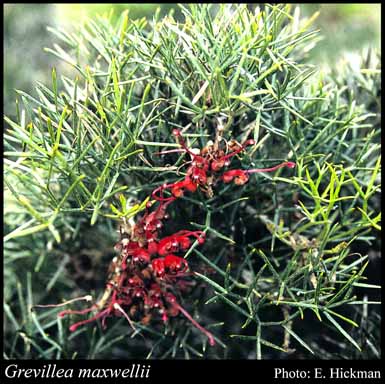
Scientific Description
Shrubs, 0.5-1 m high; branchlets hairy, not glaucous. Leaves alternate, 25-75 mm long, hairy, on the abaxial surface, the hairs curled; lamina flat, twice or more divided, pinnately divided, divided to the midrib; lobes 10-30 mm long, 1-1.5 mm wide, the margins revolute, enclosing the lower surface of the leaf blade, forming a groove either side of the midvein. Inflorescences axillary or terminal, orange, red or pink; pedicels 4-6 mm long. Perianth 8-12 mm long; tepals some joined and some free after flower opens, hairy, glandular-hairy; ovary hairy, sessile; pistil 18-22 mm long, red or pink, pollen presenter oblique, style glabrous. Follicles glandular hairy, not viscid, dehiscent, 10 mm long. Flowers in May, September, October or November. Occurs in the South-west (SW) Botanical Province(s), in the Esperance Plains (ESP) IBRA subregion(s). : Conservation code Threatened (T).
Distribution
- IBRA Regions
- Esperance Plains, Swan Coastal Plain.
- IBRA Subregions
- Fitzgerald, Perth.
- Local Government Areas (LGAs)
- Albany, Gnowangerup, Perth.