- Reference
- Fragm. (Mueller) 6:206 (1868)
- Conservation Code
- Not threatened
- Naturalised Status
- Native to Western Australia
- Name Status
- Current
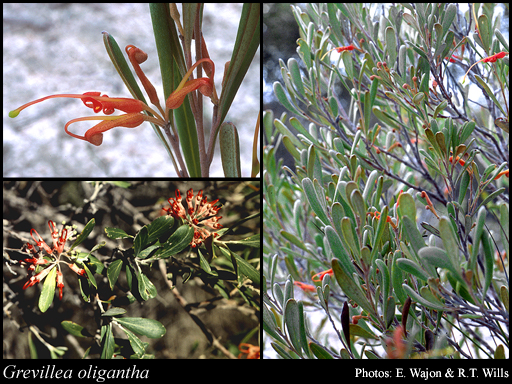
Much-branched shrub, (0.3-)0.6-1.8(-2.5) m high. Fl. red-orange-pink, Apr to Dec or Jan. Sandy or clayey loam soils over laterite or limestone, often with gravel.
Scientific Description
Shrubs, 1-2.5 m high; branchlets hairy, not glaucous. Leaves alternate, 25-70 mm long, 5-10 mm wide, hairy or glabrous, on the adaxial or abaxial surface, the hairs straight; lamina flat, clearly widest above the middle, entire, the margins recurved. Inflorescences axillary or terminal, yellow, orange or brown; pedicels 4-7 mm long. Perianth 10-15 mm long; tepals all free after flower opens, hairy, simple-hairy; ovary glabrous, stipitate, the stipe 2-3 mm long; pistil 18-25 mm long, yellow, pollen presenter lateral or oblique, style glabrous. Follicles glabrous, not viscid, dehiscent, 10-12 mm long. Flowers in May, June, July, August, September, October or November. Occurs in the Eremaean (ER) or South-west (SW) Botanical Province(s), in the Coolgardie (COO), Mallee (MAL) or Esperance Plains (ESP) IBRA subregion(s).
Distribution
- IBRA Regions
- Coolgardie, Esperance Plains, Mallee.
- IBRA Subregions
- Eastern Goldfield, Eastern Mallee, Fitzgerald, Mardabilla, Recherche, Southern Cross, Western Mallee.
- IMCRA Regions
- WA South Coast.
- Local Government Areas (LGAs)
- Albany, Broomehill-Tambellup, Dundas, Esperance, Gnowangerup, Jerramungup, Kent, Kondinin, Lake Grace, Ravensthorpe, Yilgarn.