- Reference
- Nuytsia 15(3):469-470, Fig. 1i (2005)
- Conservation Code
- Priority Three
- Naturalised Status
- Native to Western Australia
- Name Status
- Current
Erct, spreading shrub, to 0.75 m high. White gritty sand, brown, red,yellow, white or grey sand, brown-yellow sandy clay. Winter-wet sites, flats, slopes, swamps, drainage lines.
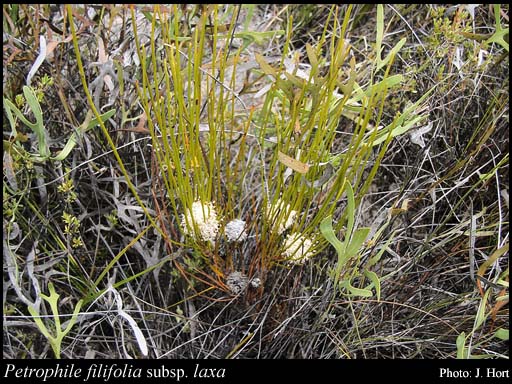
Scientific Description
Shrubs, 0.5-1 m high; branchlets glabrous. Leaves alternate, 160-350 mm long, 1-1.5 mm wide, glabrous; lamina terete, entire, straight or curved, scabrous, apex acute, 1-1.2 mm long. Inflorescences not viscid, white or cream. Perianth 14-20 mm long, hairy, the limb apex hairy all over; pistil 14-20 mm long; pollen presenter not fusiform, hairy, 5-5.6 mm long, the brush 3-4.2 mm long. Cone with persistent scales, 28-30 mm long. Flowers in November or December. Occurs in the South-west (SW) Botanical Province(s), in the Jarrah Forest (JF) IBRA subregion(s). : Conservation code Priority Three (P3).
Distribution
- IBRA Regions
- Jarrah Forest.
- IBRA Subregions
- Northern Jarrah Forest.
- Local Government Areas (LGAs)
- Armadale, Wandering.