- Reference
- Rep.Bot.Exch.Club Brit.Isles 4:625 (1917)
- Conservation Code
- Not threatened
- Naturalised Status
- Native to Western Australia
- Name Status
- Current
Much-branched, erect or spreading shrub, 0.2-1 m high. Fl. white, Apr to Dec (mainly Jul-Oct). Lateritic or granitic gravels. Hillsides, ridges.
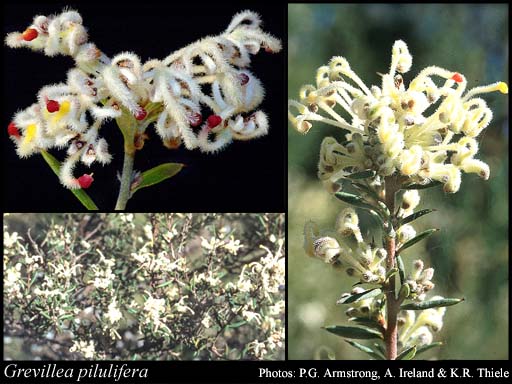
Scientific Description
Shrubs, 0.5-1 m high; branchlets hairy, not glaucous. Leaves alternate, 3-50 mm long, 1-10 mm wide, hairy, on the abaxial surface, the hairs straight; lamina flat, widest around the middle, entire, the margins recurved or revolute. Inflorescences axillary or terminal, white or cream; pedicels 6-12 mm long. Perianth 3-4 mm long; tepals all free after flower opens, hairy, simple-hairy; ovary hairy, stipitate, the stipe 0.5-1 mm long; pistil 4.5-7 mm long, white or yellow, pollen presenter lateral, style hairy. Follicles hairy, not viscid, dehiscent, 8-13 mm long. Flowers in April, May, June, July, August, September, October, November or December. Occurs in the South-west (SW) Botanical Province(s), in the Geraldton Sandplains (GS), Swan Coastal Plain (SWA), Avon Wheatbelt (AW), Jarrah Forest (JF), Mallee (MAL) or Esperance Plains (ESP) IBRA subregion(s).
Distribution
- IBRA Regions
- Avon Wheatbelt, Esperance Plains, Geraldton Sandplains, Jarrah Forest, Mallee, Swan Coastal Plain.
- IBRA Subregions
- Dandaragan Plateau, Fitzgerald, Katanning, Lesueur Sandplain, Merredin, Northern Jarrah Forest, Perth, Southern Jarrah Forest, Western Mallee.
- Local Government Areas (LGAs)
- Albany, Armadale, Belmont, Beverley, Brookton, Broomehill-Tambellup, Bunbury, Capel, Chittering, Cranbrook, Dandaragan, Dardanup, Donnybrook-Balingup, Dumbleyung, Gingin, Goomalling, Gosnells, Harvey, Kalamunda, Kojonup, Lake Grace, Moora, Mundaring, Murray, Narrogin, Northam, Perth, Pingelly, Plantagenet, Quairading, Serpentine-Jarrahdale, Swan, Tammin, Toodyay, Victoria Plains, Wagin, Wandering, Waroona, West Arthur, Williams, Woodanilling, York.