This name is not current. Find out more information on related names.
- Reference
- Fl.Ital. 3:598 (1860)
- Name Status
- Not Current
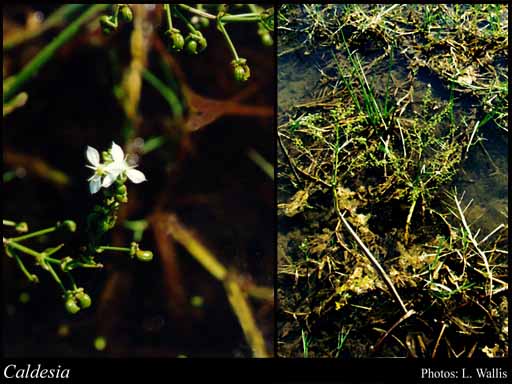
Scientific Description
Family Alismataceae.
Habit and leaf form. Aquatic herbs; laticiferous. Annual, or perennial; plants with a basal concentration of leaves; rhizomatous. Hydrophytic; rooted. Leaves emergent to floating, or submerged. Not heterophyllous, or heterophyllous (when some leaves submerged). Leaves small to large; alternate; petiolate; sheathing; simple. Leaf blades broadly ovate to elliptic (emergent leaves), or linear (submerged leaves); 9–17 -nerved; parallel-veined; cross-venulate; cordate (or rarely truncate at base). Axillary scales present. Leaf anatomy. Hairs absent. Stem anatomy. Secondary thickening absent.
Reproductive type, pollination. Fertile flowers hermaphrodite. Unisexual flowers absent. Plants hermaphrodite. Floral nectaries present. Nectar secretion from the gynoecium, or from the androecium.
Inflorescence and flower features. Flowers aggregated in ‘inflorescences’. The terminal inflorescence unit cymose, or racemose. Inflorescences scapiflorous; a pyramidal panicle, with branches and pedicels in whorls of 3; with involucral bracts, or without involucral bracts. Flowers pedicellate; bracteate (bracts narrowly ovate); regular; 3 merous; cyclic; tetracyclic. Floral receptacle developing a gynophore, or with neither androphore nor gynophore. Perigone tube absent. Perianth with distinct calyx and corolla; 6; 2 -whorled; isomerous; without spots, or spotted; different in the two whorls; white (inner), or green (outer). Calyx 3; 1 -whorled; polysepalous; green (with a translucent or scarious margin). Corolla 3; polypetalous; white. Androecium 6(–11). Androecial members branched (usually, having three stamen pairs); free of the perianth; free of one another, or coherent (? in pairs next to the petals); 1 -whorled. Androecium exclusively of fertile stamens. Stamens 6(–11); diplostemonous; alterniperianthial. Filaments filiform. Anthers dehiscing via longitudinal slits; extrorse. Gynoecium 2–20 carpelled (crowded, not in a whorl); apocarpous; eu-apocarpous; superior. Carpel with a lateral style (style inserted adaxially, medial to subterminal); 1 ovuled, or 2 ovuled. Placentation basal. Stigmas dry type; papillate; Group II type. Ovules ascending; anatropous, or amphitropous.
Fruit and seed features. Fruit non-fleshy; spinose, or not spinose; an aggregate. The fruiting carpels not coalescing. The fruiting carpel indehiscent; an achene (achenes elliptic or reniform, with 3–5 ribs, when mature forming a loose aggregation). Seeds non-endospermic; with starch. Cotyledons 1. Embryo strongly curved (horseshoe-shaped). Seedling. Hypocotyl internode present. Mesocotyl absent. Seedling collar not conspicuous. Cotyledon hyperphyll elongated; assimilatory; more or less circular in t.s. Coleoptile absent. Seedling macropodous. Seedling cataphylls absent. First leaf dorsiventral. Primary root ephemeral.
Physiology, biochemistry. Photosynthetic pathway: C3.
Geography, cytology, number of species. Native of Australia. Not endemic to Australia. Australian states and territories: Western Australia, Northern Territory, and Queensland.
Additional characters Fruit erostrate.