- Reference
- Fragm. (Mueller) 9:3 (1875)
- Conservation Code
- Not threatened
- Naturalised Status
- Native to Western Australia
- Name Status
- Current
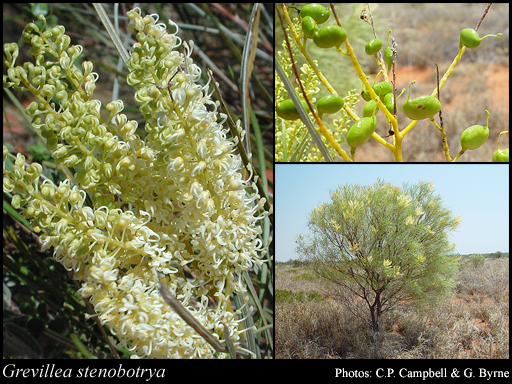
Erect or spreading shrub or tree, (1-)2-4(-6) m high. Fl. cream-white/yellow, Apr to Nov. Red sand. Sand dunes.
Scientific Description
Shrubs, 3-7 m high; branchlets hairy, not glaucous. Leaves alternate, 60-280 mm long, 0.5-2.5 mm wide, hairy, on the abaxial surface, the hairs straight; lamina flat, once divided, pinnately divided, entire or divided to the midrib; lobes 60-120 mm long, 1-2 mm wide, the margins revolute, enclosing the lower surface of the leaf blade, forming a groove either side of the midvein. Inflorescences terminal, green, white or cream; pedicels 2-5 mm long. Perianth 3-6 mm long; tepals all free after flower opens, hairy, simple-hairy; ovary glabrous, stipitate, the stipe 0.5-1.5 mm long; pistil 6-10 mm long, white, pollen presenter oblique, style glabrous. Follicles glabrous, not viscid, dehiscent, 13-16 mm long. Flowers in May, June, July, August, September, October, November or December. Occurs in the Northern (N), Eremaean (ER) or South-west (SW) Botanical Province(s), in the Great Sandy Desert (GSD), Tanami (TAN), Pilbara (PIL), Carnarvon (CAR), Gascoyne (GAS), Little Sandy Desert (LSD), Gibson Desert (GD), Central Ranges (CR), Murchison (MUR), Great Victoria Desert (GVD), Nullarbor (NUL), Dampierland (DL) or Geraldton Sandplains (GS) IBRA subregion(s).
Distribution
- IBRA Regions
- Carnarvon, Central Ranges, Dampierland, Gascoyne, Gibson Desert, Great Sandy Desert, Great Victoria Desert, Little Sandy Desert, Murchison, Nullarbor, Pilbara, Tanami, Yalgoo.
- IBRA Subregions
- Ashburton, Augustus, Cape Range, Carlisle, Carnegie, Central, Chichester, Dune Field, Eastern Murchison, Edel, Hamersley, Lateritic Plain, Mackay, Mann-Musgrave Block, Maralinga, McLarty, Nullarbor Plain, Pindanland, Roebourne, Rudall, Shield, Tanami Desert, Trainor, Western Murchison, Wooramel.
- IMCRA Regions
- Shark Bay.
- Local Government Areas (LGAs)
- Ashburton, Broome, Carnarvon, East Pilbara, Exmouth, Halls Creek, Kalgoorlie-Boulder, Laverton, Leonora, Meekatharra, Menzies, Murchison, Ngaanyatjarraku, Port Hedland, Shark Bay, Upper Gascoyne, Wiluna.