- Reference
- Hooker's J.Bot.Kew Gard.Misc. 2:492, 494, t. 13-15. (1843)
- Name Status
- Current
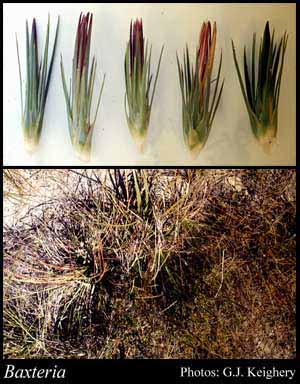
Scientific Description
Family Dasypogonaceae.
Habit and leaf form. Tufted herbs. Perennial. Leaves basal. Plants with a basal concentration of leaves (more or less acaulescent), or with neither basal nor terminal concentrations of leaves; rhizomatous (thick, short, woody). Pachycaul. Mesophytic, or xerophytic. Leaves small to large; alternate (crowded); spiral, or distichous; leathery, or modified into spines, or ‘herbaceous’; sessile; sheathing. Leaf sheaths not tubular; with free margins. Leaves simple. Leaf blades entire; acicular, or linear; linear; parallel-veined; without cross-venules; sheathing, with narrow scarious margins, sometimes lacerated. Leaves without stipules. Vegetative anatomy. Plants with silica bodies. Leaf anatomy. Extra-floral nectaries absent. Stem anatomy. Secondary thickening absent.
Reproductive type, pollination. Fertile flowers hermaphrodite. Unisexual flowers absent. Plants hermaphrodite.
Inflorescence and flower features. Flowers solitary; pedicellate, or sessile; bracteate (several surround each flower, acuminate); ebracteolate; small; regular; 3 merous; cyclic; pentacyclic. Perigone tube present, or absent. Perianth of ‘tepals’; 6; 2 -whorled; isomerous; petaloid; similar in the two whorls, or different in the two whorls; green (at the base), or purple to brown (at the apex); fleshy, or non-fleshy. Androecial members definite in number. Androecium 6. Androecial members adnate; all equal; free of one another; 2 -whorled. Androecium exclusively of fertile stamens. Stamens 6 (in 2 whorls); all more or less similar in shape; diplostemonous; on the perianth segments in the lower half, at the base. Anthers basifixed; dehiscing via longitudinal slits; introrse. Pollen shed as single grains. Gynoecium 3 carpelled. The pistil 3 celled. Carpels isomerous with the perianth. Gynoecium syncarpous; eu-syncarpous; inferior. Ovary plurilocular; 3 locular. Gynoecium stylate. Styles 1; attenuate from the ovary, or from a depression at the top of the ovary; apical. Stigmas 1; 3 - lobed. Placentation axile. Ovules 1 per locule; non-arillate; anatropous to campylotropous.
Fruit and seed features. Fruit non-fleshy; dehiscent; a capsule. Capsules septicidal and valvular. Fruit 3 celled; elastically dehiscent. Seeds endospermic. Embryo well differentiated. Testa without phytomelan.
Additional characters Pollen grains large, complex ‘unipantocolpate’.