This name is not current. Find out more information on related names.
- Reference
- Prodr.Fl.Nov.Holland. 319 (1810)
- Name Status
- Not Current
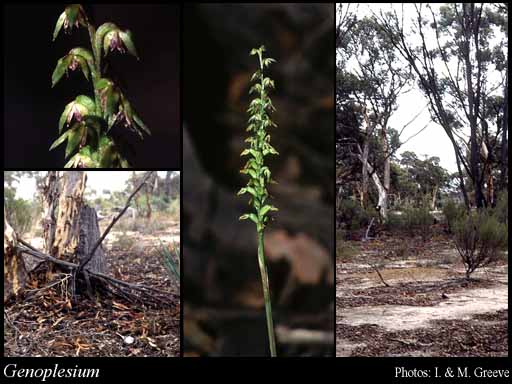
Scientific Description
Family Orchidaceae.
Habit and leaf form. Herbs; deciduous. Perennial. Leaves basal. Tuberous (tuber rounded, partially enclosed in a fibrous sheath; replacement tubers produced each year on short droppers). Mesophytic. Leaves medium-sized to large; ‘herbaceous’, or leathery; petiolate; simple. Leaf blades entire; solid; terete; linear; parallel-veined; cross-venulate, or without cross-venules. Leaf blade margins entire. Vernation conduplicate. Stem anatomy. Secondary thickening absent.
Reproductive type, pollination. Fertile flowers hermaphrodite. Unisexual flowers absent. Plants hermaphrodite. Entomophilous (small vinegar flies), or pollinated by unusual means (self-pollinating or apomictic). Pollination mechanism conspicuously specialized (the flies attracted to the flower by the fruity perfume, the dark coloured perianth or the trembling labellum).
Inflorescence and flower features. Flowers aggregated in ‘inflorescences’. Inflorescence many-flowered. Flowers in spikes. The terminal inflorescence unit racemose. Inflorescences scapiflorous, or not scapiflorous; terminal; flower spike emerges from the leaf near its apex, leaving only a bract-like free tip. Flowers minute to medium-sized; fragrant; very irregular; zygomorphic; not resupinate. The floral asymmetry involving the perianth and involving the androecium. Flowers 3 merous; cyclic; supposedly basically pentacyclic. Perigone tube absent. Perianth of ‘tepals’, or with distinct calyx and corolla; 6; 2 -whorled; isomerous (but zygomorphic); free; red to purple, or green. Calyx (if the outer whorl be so designated) 3; 1 -whorled; polysepalous. Corolla (i.e. the members of the inner whorl) 3; polypetalous; imbricate. Androecium 3, or 1 (by misinterpretation). Androecial members free of the perianth; united with the gynoecium (fused with the style to form a column or ‘gynostemium’; column tiny); coherent (via the gynostemium); 1 - adelphous; theoretically 2 -whorled. Androecium including staminodes, or exclusively of fertile stamens (by misinterpretation). Staminodes 2 (these anterior, supposedly the abaxial pair of the inner whorl). Stamens 1 (this across the flower from the labellum, i.e. anterior, supposedly representing the outer whorl); reduced in number relative to the adjacent perianth; alterniperianthial (i.e. with reference to the single stamen, across the flower from the labellum); filantherous, or with sessile anthers. Anthers dorsifixed to basifixed; dehiscing via longitudinal slits; introrse; tetrasporangiate; appendaged, or unappendaged. Pollen shed in aggregates; in the form of pollinia. Gynoecium 3 carpelled. The pistil 1 celled. Carpels isomerous with the perianth. Gynoecium syncarpous; eu-syncarpous; inferior. Ovary unilocular; 1 locular. The ‘odd’ carpel anterior (away from the labellum). Gynoecium stylate. Styles 1 (inflexed); apical. Stigmas 1; 3 - lobed (but becoming much modified in form, the apex of the median lobe forming the ‘rostellum’); wet type; papillate; Group III type. Placentation parietal. Ovules not differentiated; in the single cavity 30–100 (i.e. very numerous); non-arillate; anatropous.
Fruit and seed features. Fruit non-fleshy; dehiscent; a capsule. Capsules septicidal, or loculicidal. Fruit 30–500 seeded (i.e. seeds usually very numerous). Seeds endospermic (endosperm development arrested very early), or non-endospermic; minute; without starch. Embryo rudimentary at the time of seed release, or weakly differentiated. Seedling. Seedling collar not conspicuous. Primary root ephemeral.
Geography, cytology, number of species. Native of Australia. Not endemic to Australia. Australian states and territories: Western Australia, South Australia, Queensland, New South Wales, Victoria, Australian Capital Territory, and Tasmania. South-West Botanical Province.
Additional characters Perianth of 5 similar members and the median inner member modified into the labellum, or of 5 dissimilar members and the median inner member modified into the labellum (dorsal sepal hooded; lateral sepals divergent; labellum hinged on a small claw, with a fleshy callus; perianth segments glabrous or adorned with long or short hairs, and small glands on their tips). Leaves solitary. Leaves erect. Column prominently winged (wings variously notched, sometimes hairy). Labellum motile (in some species the labellum trembles in the slightest breeze). Perianth not glossy.