This name is not current. Find out more information on related names.
- Reference
- Nuytsia 3(3):28 (1980)
- Name Status
- Not Current
Scientific Description
Common name. Samphires. Family Chenopodiaceae.
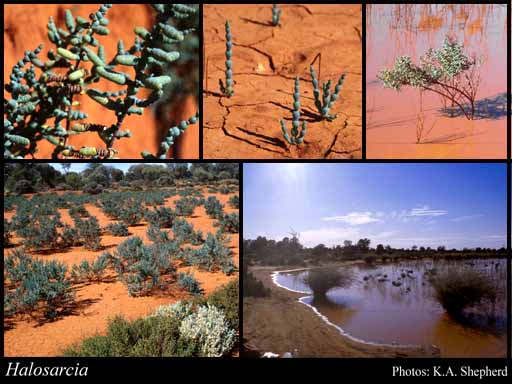
Habit and leaf form. Shrubs (dwarf or small shrub); outer portion of branches eventually shrivelling and falling off. Switch-plants; somewhat ‘cactoid’. Leaves much reduced (appearing leafless). Plants succulent (internodes succulent); unarmed. Leaves cauline. Plants with a basal concentration of leaves, or with neither basal nor terminal concentrations of leaves. Stems ‘jointed’, with fleshy internodes. Young stems cylindrical (or globose). Helophytic to xerophytic. Leaves minute to large; opposite; bladeless; fleshy; connate; simple. Leaf anatomy. Hydathodes present, or absent. Hairs absent. Extra-floral nectaries absent.
Reproductive type, pollination. Fertile flowers hermaphrodite, or functionally male and functionally female, or functionally male, or functionally female, or hermaphrodite, functionally male, and functionally female. Unisexual flowers present, or absent. Plants hermaphrodite, or monoecious, or andromonoecious, or gynomonoecious, or dioecious, or polygamomonoecious. Female flowers without staminodes. Male flowers without pistillodes.
Inflorescence and flower features. Flowers aggregated in ‘inflorescences’; in spikes (or spike-like thyrse or cymule). The terminal inflorescence unit cymose. Inflorescences terminal (usually terminal to a branchlet); cymule is a triad of flowers; spike pedunculate. Flowers sessile; bracteate (opposite bracts united or rarely free, succulent); ebracteolate; minute, or small; regular; cyclic. Hypogynous disk present, or absent. Perianth sepaline; 3 (2 lateral and 1 abaxial); 1 -whorled; joined (imbricate); fleshy, or non-fleshy; persistent; accrescent, or non-accrescent. Calyx present; not replaced by accrescent bracteoles; 3 (2 lateral and 1 abaxial); gamosepalous; blunt-lobed; imbricate; fleshy, or non-fleshy; persistent (in the fruit); accrescent, or non-accrescent. The fruiting calyx not berrylike; wingless, spineless and without tubercles. Corolla absent. Fertile stamens present, or absent (from female flowers). Androecial members definite in number. Androecium 1. Androecial members free of the perianth, or adnate (to the base of the perianth); all equal; free of one another; 1 -whorled. Androecium exclusively of fertile stamens. Stamens 1; all more or less similar in shape; isomerous with the perianth; oppositisepalous (abaxial). Anthers bent inwards in bud; dehiscing via longitudinal slits; bilocular (AKPL), or four locular (NC); tetrasporangiate. Fertile gynoecium present, or absent (from male flowers). Gynoecium (2–)5 carpelled. The pistil 1 celled. Gynoecium syncarpous; synovarious to synstylovarious; superior. Ovary unilocular; 1 locular; sessile. Gynoecium stylate. Styles 1; partially joined. Stigmas 2(–3) (N). Placentation basal. Ovules in the single cavity 1; pendulous, or ascending; non-arillate; campylotropous.
Fruit and seed features. Fruit fleshy, or non-fleshy (pericarp membranous or succulent or crustaceous or corneous); indehiscent; capsular-indehiscent, or a berry, or a nut; 1 celled. Gynoecia of adjoining flowers combining to form a multiple fruit, or not forming a multiple fruit. Fruit 1 seeded. Seeds more or less non-endospermic. Perisperm present. Cotyledons 2. Embryo curved.
Special features. 3 flowers subtended by each floral leaf.
Etymology. From the Greek for "salt" and "flesh", in reference to the succulent stems.