- Reference
- Sp.Pl. [Linnaeus] 2:204 (1753)
- Name Status
- Current
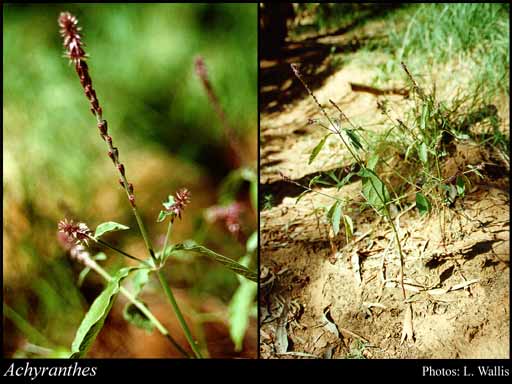
Scientific Description
Family Amaranthaceae.
Habit and leaf form. Erect or straggling, woody herbs. Annual, or perennial; plants with neither basal nor terminal concentrations of leaves. Young stems tetragonal. Leaves opposite; petiolate; simple. Leaf blades entire; elliptic, or ovate, or obovate; pinnately veined. Leaves without stipules. Leaf blade margins entire. Leaf anatomy. Hairs present, or absent.
Reproductive type, pollination. Fertile flowers hermaphrodite, or functionally male and functionally female. Unisexual flowers present, or absent. Plants hermaphrodite, or monoecious.
Inflorescence and flower features. Flowers aggregated in ‘inflorescences’; in spikes. The terminal inflorescence unit cymose. Inflorescences terminal; more or less slender, lengthening during flowering with the lower flowers becoming more distant. Flowers sessile (becoming reflexed after flowering); bracteate; bracteolate. Bracteoles spiny. Flowers regular; cyclic. Free hypanthium absent. Hypogynous disk absent. Perianth sepaline; 5. Calyx present; 5; polysepalous; glabrous; regular; green, or red to pink (tinged); dry and membranous, indurate in fruit, especially at the base; persistent; with the median member posterior. Sepals ovate. Corolla absent. Fertile stamens present, or absent. Androecium 2–5. Androecial members all equal, or markedly unequal (by misinterpretation); coherent; 1 - adelphous (the filaments connate basally forming a staminal cup); 1 -whorled. Androecium exclusively of fertile stamens (the true androecium alternating with quadrate to broadly quadrate-spathulate ‘pseudostaminodes’, these simple and dentate or fimbriate, or furnished with a variably developed dorsal scale). Stamens 2–5; oppositisepalous. Anthers dehiscing via longitudinal slits; introrse; bilocular. Pollen shed as single grains. Gynoecium 2–3 carpelled. The pistil 1 celled. Gynoecium syncarpous; eu-syncarpous; superior. Ovary unilocular; 1 locular. Gynoecium stylate. Styles 1. Stigmas 1; capitate. Placentation basal. Ovules in the single cavity 1; pendulous; non-arillate; campylotropous.
Fruit and seed features. Fruit indehiscent; capsular-indehiscent (a utricle, ellipsoidal, with truncate apex, falling with persistent perianth and bracteoles). Capsules circumscissile. Seeds cylindric; non-endospermic (strictly speaking). Perisperm present (abundant, mealy). Embryo well differentiated. Cotyledons 2. Embryo curved. Testa smooth (usually shiny).
Special features. Perianth (calyx) glabrous outside.