This name is not current. Find out more information on related names.
- Reference
- Gen.Sp.Pl. 234 (1816)
- Name Status
- Not Current
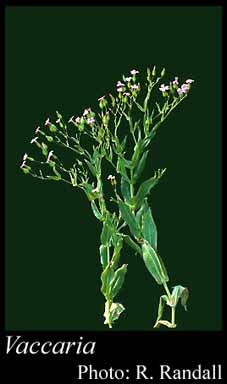
Scientific Description
Family Caryophyllaceae.
Subfamily Caryophylloideae, Tribe Caryophylleae.
Habit and leaf form. Herbs; non-laticiferous and without coloured juice. ‘Normal’ plants. Leaves well developed. Plants with roots; non-succulent; unarmed. Annual; to 0.6 m high. Self supporting. Mesophytic. Not heterophyllous. Leaves medium-sized; not fasciculate; opposite; with blades; sessile; simple; not peltate. Leaf blades entire; flat; ovate. Mature leaf blades adaxially glabrous (glaucous); abaxially glabrous. Leaves without stipules. Leaf blade margins entire; flat. Leaf anatomy. Hairs absent; glandular hairs absent.
Reproductive type, pollination. Fertile flowers hermaphrodite. Unisexual flowers absent. Plants hermaphrodite. Floral nectaries absent.
Inflorescence and flower features. Flowers aggregated in ‘inflorescences’. Inflorescence many-flowered, or few-flowered. Flowers in cymes. Inflorescences compound. The terminal inflorescence unit cymose. Inflorescences terminal. Flowers pedicellate; bracteate. Bracts scarious with green midrib. Flowers small; regular; tetracyclic. Floral receptacle with neither androphore nor gynophore (but developing an anthophore). Free hypanthium absent. Hypogynous disk present. Perianth with distinct calyx and corolla; 10; 2 -whorled; isomerous. Calyx present; 5; 1 -whorled; gamosepalous; lobed. Calyx lobes markedly shorter than the tube. Calyx glabrous; valvate; inflated below. Epicalyx absent. Corolla present; 5; 1 -whorled; polypetalous; dextrorsely contorted, or imbricate (rarely); pink, or purple. Petals dentate or notched; clawed. Corolla members entire. Androecium present. Fertile stamens present. Androecial members definite in number. Androecium 10. Androecial members all equal; free of one another; 2 -whorled. Androecium exclusively of fertile stamens. Stamens 10; diplostemonous (obdiplostemonous); oppositisepalous. Anthers separate from one another; dehiscing via longitudinal slits; introrse; bilocular; tetrasporangiate. Fertile gynoecium present. Gynoecium 1 carpelled. The pistil 1 celled. Gynoecium syncarpous; synovarious; superior. Ovary unilocular (almost 2-locular at the base); 1 locular. Gynoecium stylate. Styles 2; free; simple. Stigmas 2; 1 - lobed. Placentation free central, or basal. Ovules campylotropous.
Fruit and seed features. Fruit dehiscent; a capsule. Dispersal unit the seed. Perisperm present. Seeds minute, or small.
Geography, cytology, number of species. Holarctic. Adventive. Not endemic to Australia. Australian states and territories: Western Australia, South Australia, Northern Territory, Queensland, New South Wales, Victoria, Australian Capital Territory, and Tasmania. 2n=24?, 30, 60. A genus of 1 species, or 4 species; 1 species in Western Australia; Vaccaria hispanica (Mill.) Rauschert; 0 endemic to Western Australia.