This name is not current. Find out more information on related names.
- Reference
- Sp.Pl. [Linnaeus] 2:671 (1753)
- Name Status
- Not Current
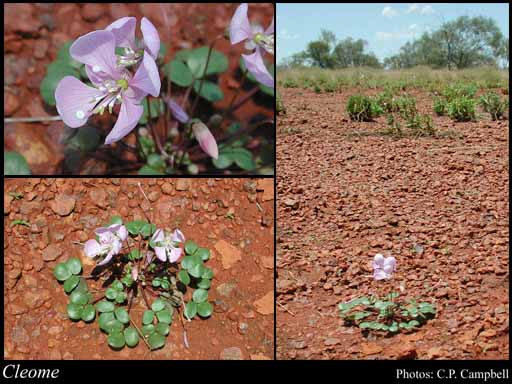
Scientific Description
Family Capparaceae.
Sometimes included in Cleomaceae.
Habit and leaf form. Shrubs, or herbs; glandular, resinous. Annual, or perennial. Leaves basal, or cauline. Stem internodes solid (ass.). Climbing (a few), or self supporting. Leaves alternate; spiral; petiolate, or sessile; non-sheathing; aromatic, or without marked odour, or foetid; simple, or compound; unifoliolate, or palmate (with 3–7 leaflets). Leaf blades dissected. Leaves with stipules, or without stipules. Stipules not spiny. Leaf anatomy. Hairs present, or absent; glandular hairs present. Extra-floral nectaries absent (ass.). Stem anatomy. Secondary thickening developing from a conventional cambial ring.
Reproductive type, pollination. Fertile flowers hermaphrodite. Unisexual flowers absent. Plants hermaphrodite.
Inflorescence and flower features. Flowers solitary, or aggregated in ‘inflorescences’; in racemes. Inflorescences terminal. Flowers pedicellate; bracteate; ebracteolate (ass.); very irregular (usually). Floral receptacle developing a gynophore, or developing an androphore and developing a gynophore. Hypogynous disk present. Perianth with distinct calyx and corolla; (4–)8(–12); 2–4 -whorled (more or less resolvable into K2+2 C4, or only theoretically so); isomerous. Calyx present; 4; represented by bristles, or not represented by bristles; polysepalous; imbricate, or open in bud; persistent, or not persistent. Corolla present; 4; 1 -whorled; alternating with the calyx; polypetalous. Petals clawed (or not clawed or tapered at base). Corolla members entire. Androecial members definite in number. Androecium 1–30. Androecial members branched (from the four primordia), or unbranched. Androecial sequence determinable, or not determinable. Androecial members when ‘many’ maturing centrifugally; free of the perianth; united with the gynoecium (fused to the gynophore), or free of the gynoecium; all equal, or markedly unequal; free of one another, or coherent (sometimes connate at base). Androecium exclusively of fertile stamens, or including staminodes. Stamens 1–30; tetradynamous (rarely), or not didynamous, not tetradynamous; all more or less similar in shape (ass.); isomerous with the perianth to polystemonous; basically oppositisepalous (i.e. with reference to the primordia). Anthers dehiscing via longitudinal slits; tetrasporangiate. Fertile gynoecium present, or absent (from male flowers). Gynoecium 2 carpelled. The pistil 1 celled. Carpels reduced in number relative to the perianth. Gynoecium syncarpous; eu-syncarpous; superior. Ovary unilocular; 1 locular. Gynoecium transverse. Ovary sessile, or stipitate. Gynoecium non-stylate, or stylate. Styles 1 or absent; apical. Stigmas 1; capitate. Placentation parietal. Ovules in the single cavity 20–50 (numerous); campylotropous.
Fruit and seed features. Fruit non-fleshy; dehiscent; a siliqua. Capsules valvular. Fruit 1 celled (ass.); 20–100 seeded (many). Seeds scarcely endospermic, or non-endospermic. Cotyledons 2. Embryo curved, or bent.
Physiology, biochemistry. Mustard-oils present.
Etymology. From Greek and Latin name of some plant of medicinal properties, probably one of the Brassicaceae.