- Reference
- Fl.Carniol. 520 (1760)
- Name Status
- Current
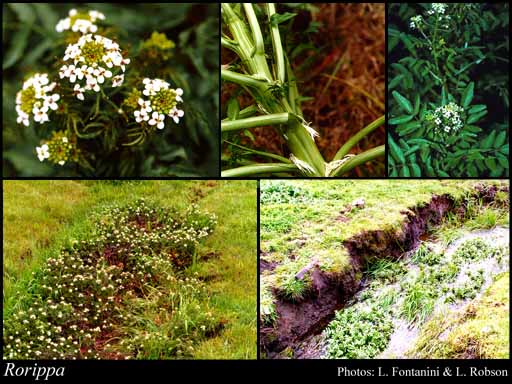
Scientific Description
Family Brassicaceae.
Habit and leaf form. Herbs. Annual, or biennial, or perennial. Leaves cauline. Plants with neither basal nor terminal concentrations of leaves. Stem internodes solid, or hollow. To 0.1–1.2 m high (or decumbent). Hydrophytic, or helophytic, or mesophytic; when hydrophytic, free floating (sometimes), or rooted. Leaves small to medium-sized; alternate; spiral; ‘herbaceous’; petiolate to sessile; sheathing to non-sheathing; foetid, or without marked odour; simple, or compound; epulvinate; when compound ternate, or pinnate; imparipinnate. Leaf blades when simple, dissected; pinnatifid, or much-divided (pinnatisect or bipinnatisect, with 3–9 lobes); pinnately veined; cross-venulate. Leaves without stipules. Leaf blade margins entire, or dentate. Leaves without a persistent basal meristem. Leaf anatomy. Hairs present, or absent; glandular hairs absent; complex hairs absent. Branched hairs absent. Extra-floral nectaries absent.
Reproductive type, pollination. Fertile flowers hermaphrodite. Unisexual flowers absent. Plants hermaphrodite.
Inflorescence and flower features. Flowers aggregated in ‘inflorescences’; in racemes, or in corymbs. The terminal inflorescence unit racemose. Flowers pedicellate; ebracteate; ebracteolate; minute to medium-sized; regular; 2 merous; cyclic. Floral receptacle with neither androphore nor gynophore. Free hypanthium absent. Hypogynous disk present; of separate members. Nectariferous glands 6. Perianth with distinct calyx and corolla; 8; 3 -whorled (K 2+2, C 4). Calyx present; 4; 2 -whorled; polysepalous; somewhat spreading, or erect; decussate; regular. Sepals inner pair saccate at base. Corolla present; 4; 1 -whorled; alternating with the calyx; polypetalous; imbricate, or contorted; regular; white, or yellow. Petals clawed. Androecial members definite in number. Androecium 4, or 6. Androecial members branched (in that the inner whorl of 4 is derived from only 2 primordia); free of the perianth; all equal, or markedly unequal; free of one another; 1 -whorled, or 2 -whorled (2+4). Androecium exclusively of fertile stamens. Stamens 4, or 6; tetradynamous, or not didynamous, not tetradynamous; all more or less similar in shape; hypogynous, on receptacle, outer stamens lateral. Filaments not appendiculate. Anthers basifixed; non-versatile; dehiscing via longitudinal slits; introrse; unilocular to bilocular; tetrasporangiate; appendaged, or unappendaged. Pollen shed as single grains. Gynoecium 2 carpelled. The pistil 2 celled. Gynoecium syncarpous; eu-syncarpous; superior. Ovary plurilocular; 2 locular. Locules secondarily divided by ‘false septa’. Gynoecium transverse. Ovary sessile. Gynoecium stylate. Styles 1; apical. Stigmas 1; commissural; 1 - lobed, or 2 - lobed; capitate. Placentation parietal. Ovules (1–)3–50 per locule; with ventral raphe; non-arillate; anatropous.
Fruit and seed features. Fruit (8–)10–60 mm long; non-fleshy; dehiscent; a siliqua. Capsules valvular. Fruit 20–100 seeded (‘many’). Seeds 10–50 per locule (‘many’). Seed rows per locule 1, or 2. Seeds scantily endospermic, or non-endospermic; mucous, or not mucous; compressed (slightly), or not compressed; small to medium sized; wingless. Embryo well differentiated. Cotyledons 2; accumbent. Embryo bent.
Physiology, biochemistry. Mustard-oils present.
Special features. Fruit body with no clear differentiation into valve and beak regions. Replum present and complete; broad. The inner (lateral) pair of sepals saccate basally for nectar storage. Petals not peculiarly elongated as in Stenopetalum. Nectariferous glands lateral and median. Valves of the fruit neither winged nor keeled; conspicuously longitudinally veined (below), or without conspicuous longitudinal veins (above); longitudinally 1 veined (below).
Etymology. Derivation uncertain.