This name is not current. Find out more information on related names.
- Reference
- Hort.Kew. [W. Aiton] 3:10 (1811)
- Name Status
- Not Current
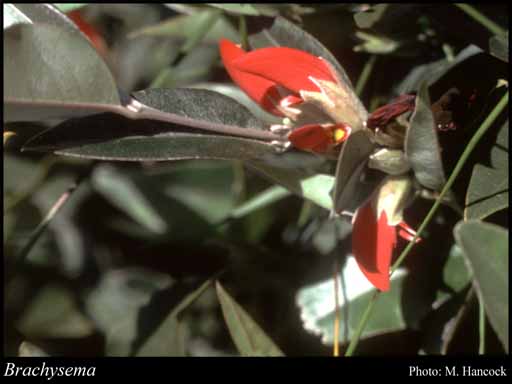
Scientific Description
Family Papilionaceae. Mirbelieae.
Sometimes included in Leguminosae.
Habit and leaf form. Shrubs (or undershrubs). ‘Normal’ plants. Leaves well developed. Plants spiny, or unarmed. The spines when present, axial. Leaves cauline. Plants with neither basal nor terminal concentrations of leaves; to 0.3–1 m high. Self supporting, or climbing; sometimes scrambling (or trailing). Xerophytic. Leaves alternate, or opposite, or whorled; when alternate, spiral; not decurrent on the stems; with blades, or bladeless; ‘usually’ leathery; sometimes petiolate; non-sheathing; simple; epulvinate. Leaf blades flat; pinnately veined; cross-venulate. Leaves with stipules. Stipules intrapetiolar. Stipules not peltate. Stipules free of one another; filiform or subulate. Leaf anatomy. Complex hairs absent (and peltate hairs absent). Stem anatomy. Secondary thickening developing from a conventional cambial ring.
Reproductive type, pollination. Fertile flowers hermaphrodite. Unisexual flowers absent. Plants hermaphrodite. Floral nectaries present. Nectar secretion from the disk. Ornithophilous.
Inflorescence and flower features. Flowers solitary, or aggregated in ‘inflorescences’; crowded at the stem bases (B. tomentosum), or not crowded at the stem bases; terminal, or axillary; usually in racemes, or in panicles. Inflorescences simple, or compound; terminal, or axillary. Flowers pedicellate to subsessile; bracteate (the bracts leaflike or variously reduced, often trifid). Bracts persistent, or deciduous. Flowers ebracteolate; small to medium-sized; very irregular; zygomorphic; resupinate. The floral asymmetry involving the perianth and involving the androecium. Flowers papilionaceous; 5 merous; pentacyclic. Floral receptacle developing a gynophore, or with neither androphore nor gynophore. Free hypanthium present, or absent. Hypogynous disk present; intrastaminal; annular. Perianth with distinct calyx and corolla; 10; 2 -whorled; isomerous. Calyx present; 5; 1 -whorled; gamosepalous; five lobed (not ribbed); toothed. Calyx lobes markedly shorter than the tube to markedly longer than the tube. Calyx erect; imbricate; exceeded by the corolla; bilabiate (the lobes more or less equal, the posterior pair more or less connate); persistent; non-accrescent; with the median member anterior. Corolla present; 5; 1 -whorled; appendiculate, or not appendiculate. Standard not appendaged. Corolla partially gamopetalous. 2 of the petals joined (the keel members ‘dorsally connate’). The joined petals anterior. The wings of the corolla free from the keel; not laterally spurred. Standard markedly reduced (and narrow, folded or recurved); entire. Keel conspicuously exceeding the wings (usually), or about equalling the wings (B. latifolium); not long-acuminate/beaked; neither coiled nor spiralled; not bent and beaked. Corolla imbricate; green, or red (usually), or yellow, or green and yellow, or black (almost). Petals clawed. Androecium present. Androecial members definite in number. Androecium 10. Androecial sequence determinable, or not determinable. Androecial members free of the perianth; all equal to markedly unequal; free of one another; 1 -whorled. Androecium exclusively of fertile stamens. Stamens 10; all more or less similar in shape to distinctly dissimilar in shape (the antesepaline members with flared bases, the antepetaline with linear or terete bases); diplostemonous; both opposite and alternating with the corolla members. Anthers connivent; all alike; dorsifixed; versatile; dehiscing via pores, or dehiscing via longitudinal slits; latrorse, or introrse; tetrasporangiate. Gynoecium 1 carpelled. The pistil 1 celled. Carpels reduced in number relative to the perianth. Gynoecium monomerous; of one carpel; superior. Carpel stylate; apically stigmatic. Style filiform. Style glabrous. Carpel 4–22 ovuled (‘several’, but ‘about 20’ in B. sericeum). Placentation marginal. Ovary subsessile to stipitate. Stigmas minutely capitate. Ovules arillate.
Fruit and seed features. Fruit stipitate to sessile; non-fleshy. The fruiting carpel dehiscent; a legume. Pods globose to much elongated; not triangular; straight, or curved; not beaked; becoming inflated, or not becoming inflated; somewhat compressed to terete; not constricted between the seeds; wingless. Fruit 1 celled. Seeds not triangular; not mucous; arillate (‘with an enlarged, persistent funicle or aril’). Cotyledons 2. Embryo bent (radicle inflexed). Testa non-operculate; homogeneous in colour. Micropyle zigzag, or not zigzag.
Physiology, biochemistry. Photosynthetic pathway: C3.
Special features. Upper lip of calyx lobed; 2 lobed. Lower lip of calyx lobed; 3 lobed.
Geography, cytology, number of species. Australian. Native of Australia. Endemic to Australia. Australian states and territories: Western Australia. Northern Botanical Province, Eremaean Botanical Province, and South-West Botanical Province. 2n=16(32); ploidy levels recorded 2 and 4. A genus of 10 species; 10 species in Western Australia.
Additional comments. Note that if Crisp (1995: ‘Brachysema has no bracteoles’) is to be believed, the cladistic data of Crisp and Weston (1995, Table 2) incorporate errors re presence of bracteoles in Leptosema and Brachysema.