- Reference
- Char.Gen.Pl. p61, t. 31. (1775)
- Name Status
- Current
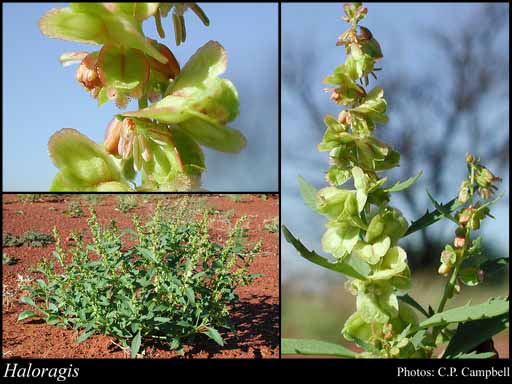
Scientific Description
Common name. Raspworts. Family Haloragaceae.
Habit and leaf form. Shrubs, or herbs. Herbs annual, or perennial. Stem growth not conspicuously sympodial (monopodial). Hydrophytic to helophytic, or mesophytic; the aquatics rooted. Leaves of hydrophytes submerged and emergent. Heterophyllous (aquatic members with submerged leaves dissected and emergent leaves more or less entire), or not heterophyllous (when not aquatic). Leaves alternate, or opposite; when alternate, spiral; petiolate, or sessile; non-sheathing; simple; epulvinate. Leaf blades dissected (pinnatifid, trifid or multifid), or entire; flat, or solid; terete; oblong, or ovate, or linear; when dissected, pinnatifid, or palmately lobed, or much-divided; one-veined, or pinnately veined. Leaves without stipules. Leaf blade margins entire, or serrate. Leaf anatomy. Hairs present, or absent.
Reproductive type, pollination. Fertile flowers hermaphrodite. Unisexual flowers absent. Plants hermaphrodite. Anemophilous.
Inflorescence and flower features. Flowers aggregated in ‘inflorescences’; in cymes. The terminal inflorescence unit cymose. Inflorescences axillary; inflorescence indeterminate and spike-like, of usually 3–7-flowered dichasia in axils of alternate bracts, with lateral inflorescences in axils of upper leaves; pseudanthial, or not pseudanthial. Flowers pedicellate; bracteolate, or ebracteolate; minute to small; regular; (2–)4 merous; cyclic; tetracyclic, or pentacyclic. Free hypanthium absent. Perianth with distinct calyx and corolla; 4, or 8; 2 -whorled; isomerous; free. Calyx present; 2–4; 1 -whorled; polysepalous; valvate; exceeded by the corolla; regular; persistent. Corolla present; 2–4; 1 -whorled; polypetalous; regular. Petals usually shortly clawed; hooded; not navicular. Androecial members definite in number. Androecium 4–8. Androecial members free of the perianth; all equal; free of one another; 1 -whorled, or 2 -whorled. Androecium exclusively of fertile stamens. Stamens 4–8 (twice the number of petals); all more or less similar in shape; isomerous with the perianth, or diplostemonous; alternisepalous and oppositisepalous; filantherous (with rather large anthers). Anthers basifixed; non-versatile; dehiscing via longitudinal slits; latrorse; four locular; tetrasporangiate. Gynoecium (2–)3–4 carpelled. The pistil 4 celled. Gynoecium syncarpous; synovarious; inferior. Ovary plurilocular; 4 locular. Epigynous disk absent. Gynoecium stylate. Styles 2–4 (usually same number as sepals); free; apical. Stigmas capitate. Placentation apical. Ovules 1 per locule; pendulous; anatropous.
Fruit and seed features. Fruit non-fleshy. Pericarp woody with solid septa. Fruit indehiscent; a nut; 1–4 locular; 1–4 seeded. Seeds more or less copiously endospermic. Endosperm oily. Cotyledons 2. Embryo straight.
Special features. Inflorescence indeterminate.
Etymology. From the Greek for "the sea" and "grape, berry"; refers to the appearance of the fruit and the habitat of the plant originally described.