- Reference
- Lehm., Pl.Preiss. [J.G.C.Lehmann] 1:557-558 (1845)
- Conservation Code
- Not threatened
- Naturalised Status
- Native to Western Australia
- Name Status
- Current
Erect shrub or tree, 2-6 m high. Fl. yellow-green, Aug to Dec. Grey or red sand, loam, sandy clay. Margins of salt marsh, plains.
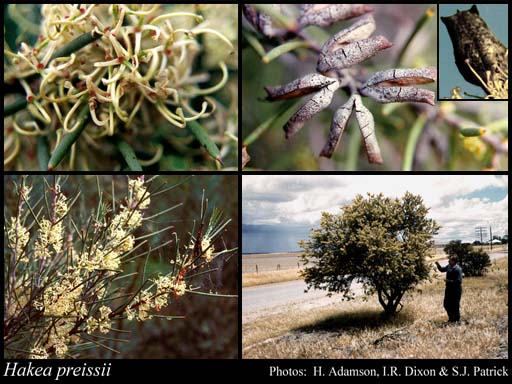
Scientific Description
Trees or Shrubs, 2-6 m high; branchlets glabrous or hairy. Leaves alternate, 13-95 mm long, 1.5-2 mm wide, glabrous; lamina terete, entire. Inflorescences axillary, cream or yellow; pedicels 5-7 mm long. Perianth 5-7 mm long, hairy; ovary glabrous; pistil 7-10 mm long, pollen presenter oblique, style glabrous. Follicles 19-25 mm long, 9-12 mm wide, corky tetrahedral projections (on external surfaces of fruit) absent; seed 17 mm long (including wing), 5-8 mm wide, the wing discontinuous, marginal, extending ± unequally down each lateral side. Flowers in August, September, October, November or December. Occurs in the Eremaean (ER) or South-west (SW) Botanical Province(s), in the Pilbara (PIL), Carnarvon (CAR), Gascoyne (GAS), Yalgoo (YAL), Murchison (MUR), Great Victoria Desert (GVD), Coolgardie (COO), Geraldton Sandplains (GS), Swan Coastal Plain (SWA), Avon Wheatbelt (AW), Jarrah Forest (JF), Mallee (MAL) or Esperance Plains (ESP) IBRA subregion(s).
Distribution
- IBRA Regions
- Avon Wheatbelt, Carnarvon, Coolgardie, Esperance Plains, Gascoyne, Geraldton Sandplains, Great Victoria Desert, Jarrah Forest, Little Sandy Desert, Mallee, Murchison, Pilbara, Swan Coastal Plain, Yalgoo.
- IBRA Subregions
- Ashburton, Augustus, Cape Range, Carnegie, Chichester, Dandaragan Plateau, Eastern Goldfield, Eastern Mallee, Eastern Murchison, Fitzgerald, Geraldton Hills, Hamersley, Katanning, Lesueur Sandplain, Mardabilla, Merredin, Northern Jarrah Forest, Shield, Southern Cross, Southern Jarrah Forest, Tallering, Trainor, Western Mallee, Western Murchison, Wooramel.
- Local Government Areas (LGAs)
- Albany, Ashburton, Beverley, Bruce Rock, Carnamah, Carnarvon, Chapman Valley, Coolgardie, Coorow, Corrigin, Cuballing, Cue, Cunderdin, Dalwallinu, Dundas, East Pilbara, Esperance, Gnowangerup, Goomalling, Greater Geraldton, Jerramungup, Kalgoorlie-Boulder, Kellerberrin, Kent, Kojonup, Kondinin, Koorda, Kulin, Lake Grace, Laverton, Leonora, Meekatharra, Menzies, Merredin, Mingenew, Moora, Morawa, Mount Magnet, Mount Marshall, Mukinbudin, Murchison, Narembeen, Narrogin, Northam, Northampton, Nungarin, Perenjori, Quairading, Ravensthorpe, Sandstone, Shark Bay, Tammin, Three Springs, Toodyay, Trayning, Upper Gascoyne, Victoria Plains, Wagin, Westonia, Wickepin, Wiluna, Wongan-Ballidu, Woodanilling, Wyalkatchem, Yalgoo, Yilgarn, York.