- Reference
- Trans.Linn.Soc.London 10:184 (1810)
- Conservation Code
- Not threatened
- Naturalised Status
- Native to Western Australia
- Name Status
- Current
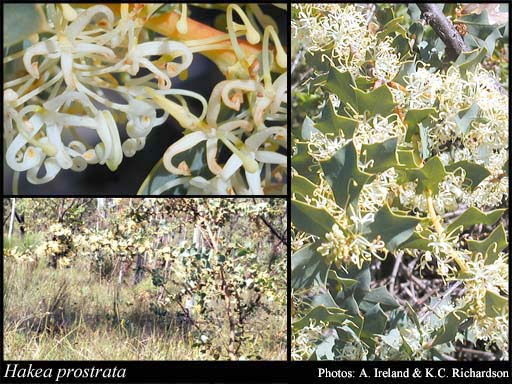
Erect to spreading or prostrate, non-lignotuberous shrub, 1-3 m high. Fl. white-cream, Jul to Oct. Sandy soils, often over laterite, loam, gravel. Hillslopes, granite outcrops, coastal dunes.
Scientific Description
Shrubs, 1-3 m high; branchlets glabrous or hairy. Leaves alternate, (15-)20-70 mm long, 5-50 mm wide, glabrous; lamina flat, clearly widest above the middle, once divided, pinnately divided, tripartitely divided or divided only at the apex, entire or shallowly divided. Inflorescences axillary, white, cream or red; pedicels 6-10 mm long. Perianth 7-9 mm long, glabrous; ovary glabrous; pistil 8.5-13 mm long, pollen presenter oblique, style glabrous. Follicles 20-38 mm long, 10-16 mm wide, corky tetrahedral projections (on external surfaces of fruit) absent; seed 18-29 mm long (including wing), 10-12 mm wide, the wing discontinuous, marginal or apical, extending ± unequally down each lateral side or extending down one lateral side only. Flowers in July, August, September or October. Occurs in the South-west (SW) Botanical Province(s), in the Geraldton Sandplains (GS), Swan Coastal Plain (SWA), Avon Wheatbelt (AW), Jarrah Forest (JF), Mallee (MAL), Warren (WAR) or Esperance Plains (ESP) IBRA subregion(s).
Distribution
- IBRA Regions
- Avon Wheatbelt, Esperance Plains, Geraldton Sandplains, Jarrah Forest, Mallee, Swan Coastal Plain, Warren.
- IBRA Subregions
- Dandaragan Plateau, Eastern Mallee, Fitzgerald, Geraldton Hills, Katanning, Lesueur Sandplain, Merredin, Northern Jarrah Forest, Perth, Recherche, Southern Jarrah Forest, Warren, Western Mallee.
- IMCRA Regions
- Central West Coast, Leeuwin-Naturaliste, WA South Coast.
- Local Government Areas (LGAs)
- Albany, Armadale, Augusta Margaret River, Beverley, Boddington, Boyup Brook, Bridgetown-Greenbushes, Brookton, Broomehill-Tambellup, Busselton, Cambridge, Capel, Carnamah, Chapman Valley, Chittering, Claremont, Cockburn, Coorow, Corrigin, Cranbrook, Cuballing, Dandaragan, Denmark, Donnybrook-Balingup, Dumbleyung, Esperance, Fremantle, Gingin, Gnowangerup, Harvey, Irwin, Jerramungup, Kalamunda, Katanning, Kent, Kojonup, Kulin, Kwinana, Lake Grace, Mandurah, Manjimup, Merredin, Mingenew, Mundaring, Murray, Narrogin, Nedlands, Northampton, Perth, Pingelly, Plantagenet, Quairading, Ravensthorpe, Rockingham, Serpentine-Jarrahdale, Swan, Three Springs, Toodyay, Victoria Plains, Wagin, Wandering, Wanneroo, Waroona, West Arthur, Westonia, Wickepin, Williams, Woodanilling, Wyalkatchem, York.