This name is not current. Find out more information on related names.
- Reference
- Prodr.Fl.Nov.Holland. 586 (1810)
- Name Status
- Not Current
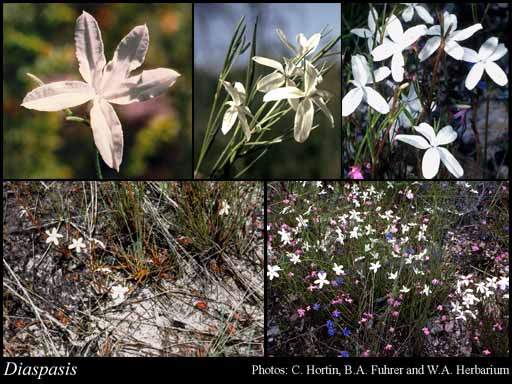
Scientific Description
Common name. Diaspasis. Family Goodeniaceae.
Habit and leaf form. Herbs. Plants unarmed. Perennial. Leaves cauline (ass.). Stem internodes solid (ass.). Mesophytic, or xerophytic. Leaves alternate; spiral; sessile; non-sheathing; simple; epulvinate. Leaf blades entire; solid (almost); terete; linear; pinnately veined. Leaves without stipules. Leaf blade margins entire, or dentate (sometimes, lower teeth rarely dilated and bordered by a few teeth). Leaves without a persistent basal meristem. Leaf anatomy. Hairs present (papillate more or less appressed hairs), or absent; complex hairs present, or absent. Extra-floral nectaries absent (ass.). Stem anatomy. Secondary thickening absent, or developing from a conventional cambial ring.
Reproductive type, pollination. Fertile flowers hermaphrodite. Unisexual flowers absent. Plants hermaphrodite. Entomophilous. Pollination mechanism conspicuously specialized (involving a cupular stylar modification for pollen presentation).
Inflorescence and flower features. Flowers solitary, or aggregated in ‘inflorescences’; in racemes (loose). The terminal inflorescence unit cymose, or racemose. Inflorescences terminal, or axillary. Flowers sessile; bracteate (opposite, similar to leaves); bracteolate (linear); small to medium-sized; very irregular. The floral asymmetry involving the perianth and involving the androecium. Flowers 5 merous; cyclic; tetracyclic. Free hypanthium absent. Perianth with distinct calyx and corolla; (8–)10; 2 -whorled; isomerous, or anisomerous. Calyx present; 5 (often unequal); 1 -whorled; gamosepalous; tubular. Calyx lobes ovate, or triangular. Corolla present; 5 (nearly equal); 1 -whorled; not appendiculate; gamopetalous; lobed. Corolla lobes markedly longer than the tube. Corolla tube not noticeably adaxially split. Corolla lobes valvate; bilabiate; white, or yellow (rarely/7/12 506 118,5 213,5 113,2 115,1 119,1). Corolla lobes oblong. Androecium 5. Androecial members free of the perianth, or adnate; all equal; free of one another; 1 -whorled. Androecium exclusively of fertile stamens. Stamens 5. Staminal insertion near the base of the corolla tube. Stamens all inserted at the same level; all more or less similar in shape (ass.); isomerous with the perianth; oppositisepalous; all alternating with the corolla members. Anthers separate from one another; basifixed; dehiscing via longitudinal slits; introrse; tetrasporangiate. Pollen shed in aggregates, or shed as single grains. Gynoecium 2 carpelled. The pistil 2 celled. Gynoecium syncarpous; synstylovarious to eu-syncarpous; inferior. Ovary plurilocular; 2 locular. Gynoecium stylate. Styles 1; bearing an ‘indusium’ beneath the stigma. Indusium cupular. Styles apical. Stigmas 1; 2 - lobed. Placentation axile. Ovules 1 per locule; ascending; non-arillate; anatropous.
Fruit and seed features. Fruit non-fleshy; indehiscent; a drupe, or a nut; 1–2 seeded (per locule). Seeds copiously endospermic. Endosperm oily. Seeds winged, or wingless. Cotyledons 2. Embryo straight.
Special features. The upper lip of the corolla incorporating 2 members, the lower 3; (posterior, adaxial) lip of the corolla bilobed. Lower (abaxial) lip of the corolla 3 lobed.
Etymology. From the Greek for "a tearing asunder, separation"; refers to the deeply divided and spreading corolla-lobes.