- Reference
- Trans.Linn.Soc.London 10:183 (1810)
- Conservation Code
- Not threatened
- Naturalised Status
- Native to Western Australia
- Name Status
- Current
Erect or spreading shrub, 1-4 m high, to 3 m wide. Fl. white-cream/yellow, Jul to Nov. White, grey or red loamy sand, clay loam, laterite. Seasonally-wet flats.
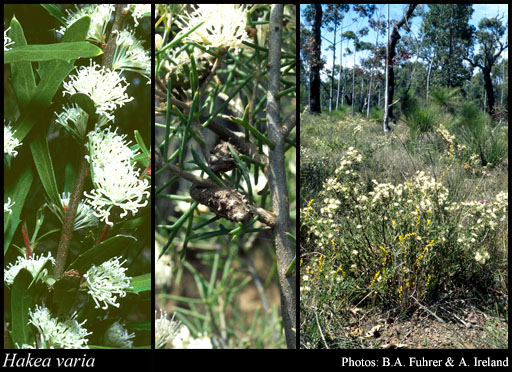
Scientific Description
Shrubs, 1-4 m high; branchlets glabrous or hairy. Leaves alternate, 10-45 mm long, 1-9 mm wide, glabrous; lamina terete or flat, clearly widest above the middle or more or less the same width throughout, once divided, pinnately divided, tripartitely divided or divided only at the apex, entire, shallowly divided, deeply divided or divided to the midrib. Inflorescences terminal, white; pedicels 6-7 mm long. Perianth 4-5 mm long, glabrous; ovary glabrous; pistil 4-5 mm long, pollen presenter conical, style glabrous. Follicles 16-20 mm long, 7-10 mm wide, corky tetrahedral projections (on external surfaces of fruit) absent; seed 11-14 mm long (including wing), the wing discontinuous, marginal, extending down one lateral side only. Flowers in July, August, September, October or November. Occurs in the South-west (SW) Botanical Province(s), in the Geraldton Sandplains (GS), Swan Coastal Plain (SWA), Avon Wheatbelt (AW), Jarrah Forest (JF), Mallee (MAL), Warren (WAR) or Esperance Plains (ESP) IBRA subregion(s).
Distribution
- IBRA Regions
- Avon Wheatbelt, Esperance Plains, Geraldton Sandplains, Jarrah Forest, Mallee, Swan Coastal Plain, Warren.
- IBRA Subregions
- Eastern Mallee, Fitzgerald, Katanning, Lesueur Sandplain, Northern Jarrah Forest, Perth, Recherche, Southern Jarrah Forest, Warren, Western Mallee.
- IMCRA Regions
- Leeuwin-Naturaliste, WA South Coast.
- Local Government Areas (LGAs)
- Albany, Armadale, Augusta Margaret River, Bayswater, Belmont, Beverley, Boddington, Boyup Brook, Bridgetown-Greenbushes, Bunbury, Busselton, Canning, Capel, Cockburn, Collie, Coorow, Cranbrook, Cuballing, Dandaragan, Dardanup, Denmark, Donnybrook-Balingup, Esperance, Gingin, Gnowangerup, Gosnells, Harvey, Irwin, Jerramungup, Kalamunda, Katanning, Kent, Kojonup, Mandurah, Manjimup, Mundaring, Murray, Nannup, Perth, Plantagenet, Ravensthorpe, Rockingham, Serpentine-Jarrahdale, Swan, Toodyay, Victoria Plains, Wagin, Wandering, Waroona, West Arthur, Williams, York.