- Reference
- Fragm. (Mueller) 8:36 (1874)
- Name Status
- Current
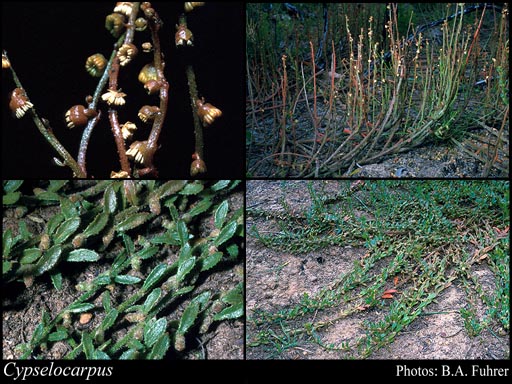
Scientific Description
Family Gyrostemonaceae.
Habit and leaf form. Herbs. Annual. Leaves cauline. Young stems cylindrical. Stem internodes solid. Xerophytic. Leaves small, or medium-sized; alternate; spiral; fleshy, or ‘herbaceous’ to leathery; sessile; non-sheathing; simple; epulvinate. Leaf blades entire; solid; terete; linear, or lanceolate, or oblanceolate, or oblanceolate, or ovate; narrowly ovate to obovate, or linear; one-veined, or pinnately veined. Leaves with stipules (small, inconspicuous). Leaf blade margins entire. Leaves without a persistent basal meristem. Leaf anatomy. Hairs absent. Extra-floral nectaries absent. Stem anatomy. Secondary thickening developing from a conventional cambial ring.
Reproductive type, pollination. Fertile flowers hermaphrodite, or functionally male, or functionally female. Unisexual flowers present, or absent. Plants hermaphrodite, or dioecious. Female flowers without staminodes. Male flowers without pistillodes.
Inflorescence and flower features. Flowers solitary (female flowers), or aggregated in ‘inflorescences’; in racemes (male flowers). The terminal inflorescence unit racemose. Inflorescences terminal (male flowers), or axillary (male and female flowers); axis of male inflorescence erect, not growing out. Flowers pedicellate (up to 1 mm long in both male and female flowers); bracteate (male flowers leaf-like, female flowers bract-like); bracteolate; small; regular; cyclic. Perianth sepaline; 4–5 (if segments detectable); 1 -whorled; joined. Calyx present; 4, or 5 (when lobed); 1 -whorled; gamosepalous; entire (male flowers), or lobed (female flowers); female flowers, blunt-lobed; regular; persistent. Corolla absent. Fertile stamens present, or absent. Androecial members definite in number. Androecium 8–10. Androecial sequence determinable, or not determinable. Androecial members when in more than one cycle, maturing centripetally; free of the perianth; all equal; free of one another; 1–5 -whorled. Androecium exclusively of fertile stamens. Stamens 8–10 (in 1 whorl); all more or less similar in shape; polystemonous; around the edge of the expanded receptacle; filantherous (almost sessile). Anthers dehiscing via longitudinal slits; introrse. Fertile gynoecium present, or absent. Gynoecium 1 carpelled. The pistil (2–)5–25 celled. Gynoecium apocarpous to syncarpous; semicarpous to synovarious (the carpels adnate to the central column, forming a compound ovary); superior. Carpel stylate; apically stigmatic; 1 ovuled. Placentation marginal. Ovary plurilocular; (if viewed as syncarpous) (2–)5–25 locular (i.e. as many locules as carpels). Gynoecium stylate. Styles 1; from a depression at the top of the ovary; apical. Stigmas (2–)5–25, or the ring of stigmas forming a corona. Placentation axile. Ovules 1 per locule; apotropous; arillate; anatropous.
Fruit and seed features. Fruit non-fleshy; interpretable as an aggregate (if seen as resulting from more or less ‘free’ carpels). The fruiting carpels coalescing into a secondary syncarp to not coalescing. The fruiting carpel indehiscent. Fruit a schizocarp (the carpels separating from the central column), or dehiscent and a schizocarp. Mericarps comprising follicles, or comprising ‘legumes’. Fruit 1 celled; 1 seeded. Seeds copiously endospermic. Endosperm oily. Embryo well differentiated. Cotyledons 2. Embryo curved.
Physiology, biochemistry. Mustard-oils present.
Etymology. From the Greek for "any hollowed out vessel" and "fruit"; the fruit is deeply depressed at the apex.