- Reference
- Anal.Fam.Pl. p60, 62 (1829)
- Name Status
- Current
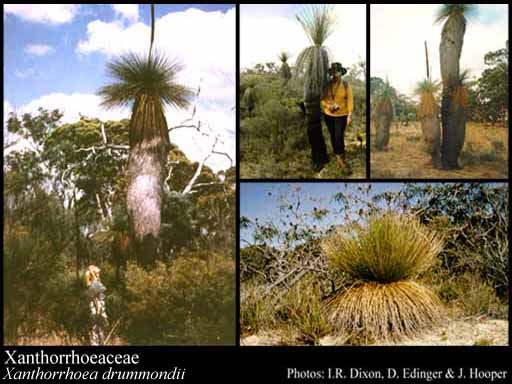
Scientific Description
Common name. Grasstree Family.
Habit and leaf form. Shrubs, or ‘arborescent’ (the habit characteristic, the trunk up to 2 m, or almost acaulescent); evergreen; resinous. Plants with a basal concentration of leaves (when acaulescent), or with terminal rosettes of leaves; rhizomatous, or tuberous. Pachycaul. Xerophytic. Leaves small to very large; alternate; spiral; leathery; sessile; sheathing (initially), or non-sheathing (subsequently). Leaf sheaths not tubular; with free margins. Leaves simple. Leaf blades entire; linear; parallel-veined; without cross-venules. Stem anatomy. Secondary thickening anomalous; from a single cambial ring.
Reproductive type, pollination. Fertile flowers hermaphrodite. Unisexual flowers absent. Plants hermaphrodite.
Inflorescence and flower features. Flowers aggregated in ‘inflorescences’. Inflorescences scapiflorous; terminal; complex, dense, spikelike, multiflorous, pedunculate. Flowers bracteate; bracteolate; small; regular; 3 merous; cyclic; pentacyclic. Perigone tube absent. Hypogynous disk absent. Perianth of ‘tepals’; 6; 2 -whorled; isomerous; free; sepaloid (or bractlike); different in the two whorls (the outer members stiffer and shorter). Androecium 6. Androecial members free of the perianth; all equal; free of one another; 2 -whorled. Androecium exclusively of fertile stamens. Stamens 6; diplostemonous. Anthers dorsifixed; dehiscing via longitudinal slits; introrse. Pollen shed as single grains. Gynoecium 3 carpelled. The pistil 3 celled. Carpels isomerous with the perianth. Gynoecium syncarpous; eu-syncarpous; superior. Ovary plurilocular; 3 locular. Gynoecium stylate. Styles 1; attenuate from the ovary; apical. Stigmas 1; trilobate, capitate or punctiform. Placentation axile. Ovules 3–8 per locule (‘a few’); horizontal, or ascending; non-arillate; anatropous.
Fruit and seed features. Fruit non-fleshy; dehiscent; a capsule (woody or cartilaginous). Capsules loculicidal. Fruit 3–6 seeded. Seeds endospermic. Endosperm oily. Cotyledons 1. Embryo straight, or curved (situated transversely). Testa encrusted with phytomelan. Seedling. Mesocotyl absent. Seedling collar not conspicuous. Cotyledon hyperphyll elongated. Coleoptile absent. First leaf dorsiventral. Primary root ephemeral.
Geography, cytology, number of species. Australian. World distribution: Australia. X = 22. 66 species.