This name is not current. Find out more information on related names.
- Reference
- Theoria Syst.Pl. 27 (1858)
- Name Status
- Not Current
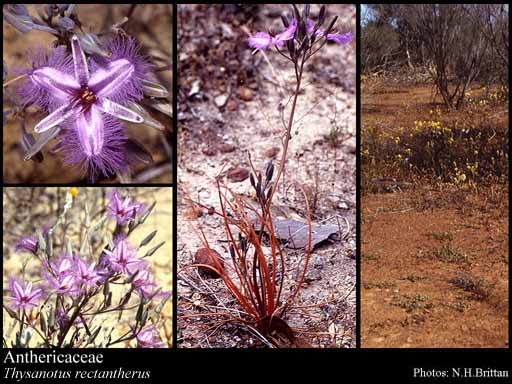
Scientific Description
Family Sometimes included in Liliaceae.
Habit and leaf form. Herbs, or shrubs, or herbaceous climbers; evergreen, or deciduous. ‘Normal’ plants, or switch-plants; the switch forms with the principal photosynthesizing function transferred to stems. Leaves much reduced (in some Australian genera), or well developed. Perennial; plants with a basal concentration of leaves, or with neither basal nor terminal concentrations of leaves; cormous, or rhizomatous, or tuberous. Self supporting, or climbing. Mesophytic, or xerophytic. Leaves alternate; spiral (usually), or distichous (rarely); ‘herbaceous’, or leathery, or membranous; petiolate (rarely), or sessile; sheathing. Leaf sheaths not tubular; with free margins. Leaves edgewise to the stem (e.g. Johnsonia), or with ‘normal’ orientation; simple. Leaf blades entire; flat, or folded, or solid (or triquetrous); linear (usually), or lanceolate, or oblong, or ovate; parallel-veined; without cross-venules. Leaves ligulate (rarely), or eligulate. Leaf blade margins entire. Stem anatomy. Secondary thickening absent.
Reproductive type, pollination. Fertile flowers hermaphrodite. Unisexual flowers absent. Plants hermaphrodite. Floral nectaries present. Nectar secretion from the gynoecium (from septal nectaries).
Inflorescence and flower features. Flowers aggregated in ‘inflorescences’; in panicles, in racemes, in spikes, in heads, and in umbels. The terminal inflorescence unit cymose, or racemose (simple or compound). Inflorescences scapiflorous; terminal; very varied, even including spikes resembling large grass spikelets in Johnsonia; with involucral bracts, or without involucral bracts; pseudanthial, or not pseudanthial. Flowers small, or medium-sized; regular; 3 merous; cyclic; pentacyclic (usually), or tetracyclic. Perigone tube present, or absent. Perianth with distinct calyx and corolla (the whorls sometimes quite different), or of ‘tepals’; 6; 2 -whorled (3+3); isomerous; free, or joined (sometimes with a basal tube); petaloid; similar in the two whorls, or different in the two whorls; white, or red, or yellow, or blue, or violet (mostly white, yellow, blue, rose or violet). Calyx (if the outer whorl so interpreted) 3; 1 -whorled; regular. Corolla (if the inner whorl so interpreted) 3; 1 -whorled; regular. Corolla members sometimes fringed. Androecium 6 (usually), or 3 (in several genera). Androecial members free of the perianth, or adnate (to the perianth); all equal, or markedly unequal; free of one another, or coherent; when joined, 1 - adelphous (basally connate); 1 -whorled, or 2 -whorled. Androecium exclusively of fertile stamens, or including staminodes (e.g. in Sowerbaea spp., Hodgsonia). Staminodes when present, 3. Stamens 3, or 6; isomerous with the perianth, or diplostemonous; alterniperianthial, or oppositiperianthial. Anthers dorsifixed, or basifixed; dehiscing via longitudinal slits; introrse; tetrasporangiate. Gynoecium 3 carpelled. The pistil 3 celled. Carpels isomerous with the perianth. Gynoecium syncarpous; synstylovarious, or eu-syncarpous; superior. Ovary plurilocular; 3 locular. Gynoecium stylate. Styles 1; almost ‘gynobasic’ (Tricoryne), or apical. Stigmas 2–3 - lobed; usually dry type. Placentation axile. Ovules 2–50 per locule (to ‘many’); arillate, or non-arillate; campylotropous (generally), or anatropous.
Fruit and seed features. Fruit non-fleshy; dehiscent (usually), or a schizocarp (rarely); usually a capsule. Capsules loculicidal. Seeds endospermic. Cotyledons 1. Embryo achlorophyllous (2/2); straight to curved. Seedling. Hypocotyl internode present, or absent. Seedling collar not conspicuous. Cotyledon hyperphyll elongated, or compact; assimilatory, or non-assimilatory; more or less circular in t.s. Coleoptile present, or absent. Seedling cataphylls absent. First leaf centric, or dorsiventral. Primary root ephemeral.
Geography, cytology, number of species. Holarctic, Paleotropical, Neotropical, Cape, Australian, and Antarctic. World distribution: widespread. About 250 species.